Strength and conditioning can improve what your body produces, but you still need enough joint range and control to use that strength effectively.
Years of lifting, running, combat sports, desk work, and repetitive movement can gradually change how comfortably the hips, shoulders, ankles, and spine move. A fighter might notice it when rotating into a kick. A lifter may struggle to reach a comfortable squat depth. Someone returning from time off may simply feel stiff during movements that once felt natural.
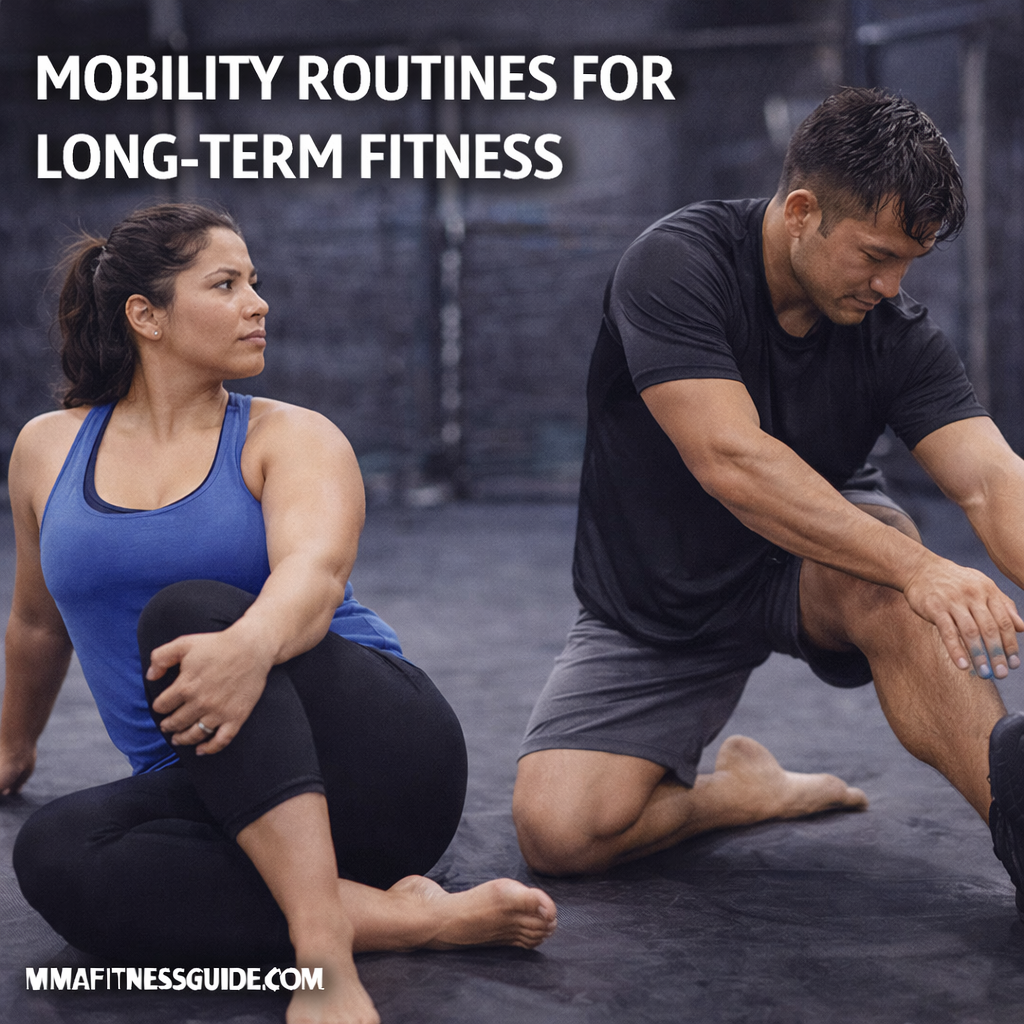
Mobility training addresses these limitations through controlled movement, active range-of-motion work, and exercises that build strength within the ranges you use.
What Mobility Really Means
Mobility and flexibility describe related but different physical qualities.
Flexibility generally refers to how far muscles and surrounding tissues can lengthen.
Mobility describes your ability to actively move and control a joint through its available range.
For example, being able to pull your leg high with your hands demonstrates flexibility. Raising that leg to a similar height under your own muscular control requires mobility.
Mobility therefore involves:
- Joint range of motion
- Muscular control
- Coordination
- Stability
- Strength within different joint positions
For athletes, the goal is not simply achieving a larger range. The goal is being able to control that range during training and movement.
Why Mobility Changes Over Time
The body adapts to the positions and movements it encounters regularly.
Someone who spends hours sitting may become accustomed to keeping the hips and knees flexed. A runner repeats thousands of similar strides. A boxer spends large amounts of training time in a fighting stance. A weightlifter repeatedly works through specific movement patterns.
None of these activities automatically causes poor mobility, but repeatedly using certain ranges while rarely exploring others can contribute to stiffness or movement restrictions.
Mobility work gives joints regular opportunities to move through ranges that normal training or daily life may not consistently reach.
Common Causes of Mobility Loss
Changes in mobility often develop gradually.
Contributing factors can include:
- Long periods of sitting or inactivity
- Repetitive training patterns
- Limited movement variety
- Previous injuries
- Avoiding certain joint positions
- Inadequate recovery
- Training around restrictions instead of addressing them
- Long periods away from physical activity
Age can also influence movement capacity, but becoming older does not mean useful range of motion has to disappear. Regular movement and resistance training can help preserve physical function.
Areas Worth Prioritizing
A full-body mobility routine does not require dozens of exercises. Start with joints that influence common athletic movements.
Hips
The hips contribute to squatting, running, kicking, changing levels, rotating, and getting up from the ground.
Useful drills include:
- 90/90 hip transitions
- Hip circles
- Controlled hip rotations
- Deep squat holds with movement
- Hip-flexor mobilizations
Ankles
Limited ankle dorsiflexion can affect squatting, lunging, running mechanics, stance, and changes of direction.
Useful drills include:
- Knee-to-wall mobilizations
- Ankle circles
- Controlled calf raises
- Calf stretches
Thoracic Spine
The thoracic spine is the middle and upper portion of the back. Its ability to rotate and extend contributes to punching, reaching, overhead movements, grappling, and posture.
Useful drills include:
- Open-book rotations
- Quadruped thoracic rotations
- Controlled trunk rotations
- Cat-cow variations
Shoulders
Shoulder mobility influences pressing, pulling, punching, clinching, swimming, throwing, and overhead movement.
Useful drills include:
- Controlled arm circles
- Wall slides
- Shoulder rotations
- Scapular push-ups
- Light band movements
Neck
The neck benefits from controlled movement, particularly for athletes involved in grappling or combat sports.
Use gentle rotations, nodding movements, and side-to-side motion rather than aggressively pulling the head into extreme positions.
Mobility vs. Stretching
Static stretching can increase or maintain range of motion, but it does not address every component of mobility.
A more complete routine can combine:
Static stretching to spend time in restricted positions.
Dynamic movement to repeatedly move through a range.
Controlled joint rotations to explore the available movement of a joint.
Strength exercises to develop control within that range.
Consider a deep squat as an example. Stretching the calves and hips might make the position easier to reach, but controlling a squat also requires strength, balance, coordination, and adequate movement at several joints.
This is why mobility work should eventually connect to actual movement rather than ending with passive stretching alone.
A Simple 10–15 Minute Daily Mobility Routine
This routine covers several areas commonly affected by training and prolonged sitting.
1. Controlled Neck Movements — 30–60 Seconds
Slowly look left and right, then move through comfortable nodding and side-bending ranges.
Avoid forcing the neck farther with your hands.
2. Shoulder Circles — 5 Each Direction
Move slowly through the largest comfortable circle you can control.
Keep the movement smooth rather than swinging the arms quickly.
3. Thoracic Rotations — 6–8 Each Side
From a kneeling or quadruped position, rotate through the upper back while keeping the movement controlled.
4. 90/90 Hip Transitions — 8–10 Repetitions
Move the knees from one side to the other while maintaining as much control as your current mobility allows.
Use your hands for support if necessary.
5. Hip Circles — 5 Each Direction Per Side
Lift one knee and slowly guide the hip through a comfortable circular range.
6. Knee-to-Wall Ankle Mobilization — 8–10 Each Side
Drive the knee forward toward a wall while keeping the heel planted.
Adjust the foot position so the movement remains controlled.
7. Deep Squat Mobility — 30–60 Seconds
Sit into a comfortable squat and gently shift your weight while maintaining control.
If necessary, hold onto a stable support while developing the position.
The entire sequence should take roughly 10–15 minutes.
Daily Mobility vs. Dedicated Sessions
Mobility training can be divided between short daily work and longer targeted sessions.
Short daily sessions work well for maintaining movement and addressing stiffness. Five or ten minutes can easily be attached to a workout warm-up or morning routine.
Dedicated sessions allow more time to address specific restrictions. These may include longer mobility drills, stretching, light strength work, and movement practice.
A fighter with restricted hip rotation, for example, might perform general mobility before training and then dedicate additional time to hip work on a recovery day.
Mobility for Strength Training
Mobility limitations can change lifting technique.
Restricted ankle movement may cause the heels to rise during a squat. Limited shoulder movement may make overhead pressing uncomfortable. Poor hip control can make deep squatting or lunging harder to stabilize.
Mobility work can support movements such as:
- Squats
- Lunges
- Deadlifts
- Overhead presses
- Rows
- Olympic lifting variations
However, mobility should not be treated as a substitute for technique or strength.
Once adequate range is available, gradually strengthening that range helps make it useful.
Mobility for MMA and Combat Sports
Combat sports place the body in positions rarely encountered during conventional gym workouts.
Striking requires hip rotation, trunk rotation, shoulder movement, and ankle control. Wrestling adds level changes, sprawls, pivots, and explosive transitions. Grappling introduces deep hip positions and substantial demands on the shoulders and spine.
For MMA athletes, useful mobility work can include:
- 90/90 hip transitions
- Adductor mobility
- Hip rotations
- Thoracic rotations
- Ankle dorsiflexion drills
- Shoulder rotations
- Deep squat movements
The closer mobility work becomes to the positions encountered during training, the easier it is to apply that range during actual movement.
Mobility for Cardio and Conditioning
Running, cycling, rowing, swimming, and conditioning circuits all involve repeated movement.
When fatigue increases, athletes may shorten their stride, lose posture, or compensate around restricted joints.
Mobility work can support comfortable movement through the ankles, hips, shoulders, and spine, while strength and technique determine how well those positions are maintained under fatigue.
For runners, ankle and hip mobility may deserve additional attention. Swimmers may prioritize the shoulders and thoracic spine. Fighters performing conditioning circuits often benefit from addressing the entire body.
Controlled Articular Rotations
Controlled articular rotations, often called CARs, involve slowly moving a joint through its available range while minimizing unnecessary movement elsewhere.
A shoulder CAR, for example, involves guiding the arm through a large controlled circle rather than quickly swinging it.
CARs can be used to:
- Explore current joint range
- Practice controlling different joint positions
- Identify movements that feel restricted
- Introduce gentle movement before harder training
They can be performed for the shoulders, hips, ankles, wrists, and other joints.
Move slowly enough that you can notice where the movement becomes difficult rather than simply completing the repetition.
Mobility After Injury or Time Away From Training
Returning after an injury or extended break is not the time to immediately chase your previous range of motion.
Begin with movements you can perform comfortably and under control.
A gradual return might involve:
- Establishing comfortable movement
- Reintroducing range of motion
- Strengthening the available range
- Increasing resistance or speed
- Returning to more demanding sport-specific movement
Pain, significant weakness, instability, swelling, or persistent loss of motion warrants assessment by an appropriate healthcare professional.
Mobility drills should not be used to force an injured joint through symptoms.
Breathing During Mobility Work
Breathing changes the position of the ribs, abdomen, and trunk, which can influence how certain mobility drills feel.
Instead of holding your breath while trying to force additional range, maintain controlled breathing.
During slower drills, try inhaling normally and using a relaxed exhale as you settle into the position.
Breathing is particularly useful during:
- Deep squat holds
- Hip stretches
- Thoracic mobility exercises
- Recovery sessions
- Longer static positions
The purpose is not to magically create additional flexibility. It is to avoid unnecessary tension while you work through the movement.
Common Mobility Mistakes
Forcing Painful Positions
More range is not automatically better. Sharp pain, joint pinching, numbness, or instability are signals to stop rather than push farther.
Moving Too Quickly
Fast repetitions can hide restricted portions of a movement. Slow the exercise down enough to maintain control.
Chasing Flexibility Without Strength
New range becomes more useful when you can actively control it. Pair mobility exercises with appropriate resistance training.
Treating Every Restriction the Same Way
A movement can feel limited for several reasons. Stretching harder is not always the answer.
Doing Endless Mobility Work Before Training
A warm-up should eventually prepare you for the activity ahead. After addressing key restrictions, transition into increasingly specific movements for your workout or sport.
How Often Should You Train Mobility?
Mobility work generally fits well into training because low-intensity drills can be performed frequently.
A practical schedule could include:
- 5–10 minutes before training: Dynamic mobility relevant to the upcoming workout
- 5–15 minutes on most days: Light full-body or targeted mobility
- 1–3 times per week: Longer sessions addressing specific limitations
The exact amount depends on your training schedule and current movement restrictions.
Someone who already moves comfortably through the ranges required by their sport may need relatively little additional work. Someone returning after years of inactivity may benefit from more frequent practice.
How to Track Mobility Progress
You do not need extreme before-and-after flexibility tests to determine whether mobility work is helping.
Look for practical changes.
Can you squat more comfortably while keeping your heels down?
Can you rotate through your upper back without compensating through the lower back?
Can you raise your arms overhead without excessive arching?
Can you move into your fighting stance, kick, change levels, or grapple with less restriction?
Other useful signs include:
- Greater range under control
- Less stiffness during warm-ups
- Smoother movement
- Improved comfort in previously difficult positions
- Better control near the end of your available range
Track movements that actually matter to your training rather than chasing arbitrary flexibility numbers.
Mobility and Aging
Maintaining movement capacity becomes increasingly relevant as the years of training accumulate.
Daily activities such as getting down to the floor, standing back up, reaching overhead, turning, walking, and climbing stairs all require combinations of mobility, strength, coordination, and balance.
Resistance training, regular physical activity, and mobility work can therefore complement each other.
Instead of training mobility simply to become “more flexible,” focus on preserving the ranges required for the activities you want to continue doing.
Making Mobility Part of Your Training
Mobility is easier to maintain when it already has a place in your schedule.
Try attaching it to something you consistently do:
- Perform ankle and hip mobility before lower-body training.
- Add shoulder and thoracic movements before striking or upper-body workouts.
- Use a short full-body routine after prolonged sitting.
- Perform longer targeted work during recovery sessions.
- Reassess restricted movements every few weeks.
This removes the need to constantly find separate time for another workout.
Keep the Range You Need
Long-term fitness requires more than producing strength or completing hard conditioning sessions. Your joints also need enough usable range to perform the movements your training demands.
Mobility work helps maintain that range by combining movement, control, and strength rather than simply pushing joints farther.
Five or ten focused minutes incorporated into regular training can be more practical than sporadic hour-long mobility sessions. Pay attention to the hips, ankles, shoulders, and spine, strengthen the ranges you gain, and prioritize movement you can control.
The objective is straightforward: keep your body capable of performing the activities you want to be doing years from now.