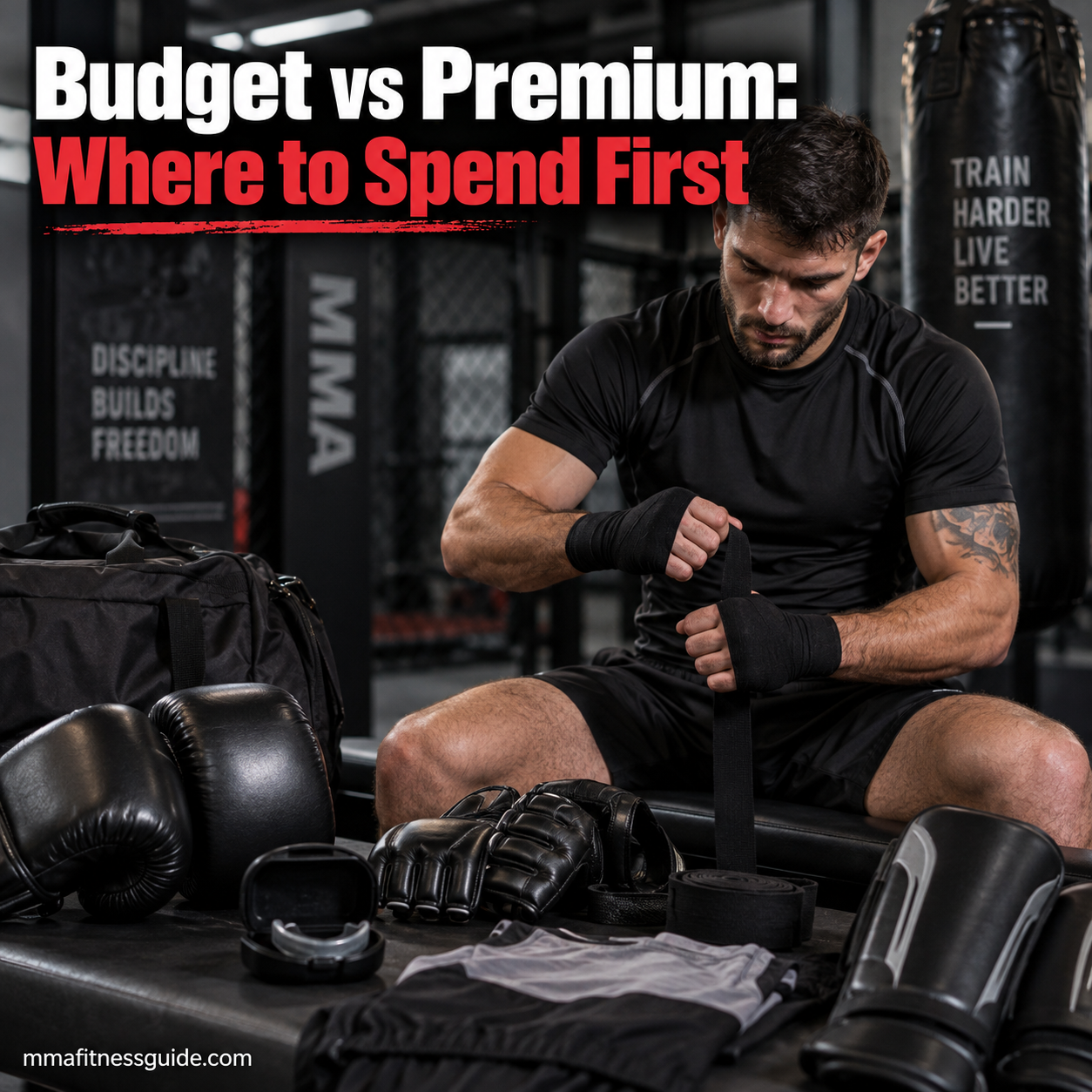
Building an MMA training kit can get expensive quickly. Between boxing gloves, MMA gloves, shin guards, mouthguards, rash guards, and training accessories, even a beginner can spend several hundred dollars before stepping onto the mats.
The challenge isn’t simply finding the cheapest equipment. It’s understanding which purchases deserve more of your budget and which can be kept affordable without sacrificing comfort, protection, or training quality.
A $150 pair of gloves might last significantly longer than a poorly constructed $40 pair. On the other hand, a $100 training shirt might offer little practical advantage over a comfortable $25 alternative.
The goal is to spend more where quality makes a meaningful difference and save where it doesn’t.
Here’s how budget and premium MMA equipment actually compare, what to look for in each category, and how to build a purchasing strategy around your experience, training frequency, and budget.
Whether you’re preparing for your first MMA class or replacing equipment after years of training, understanding the difference between price and value will help you make better decisions.
The Real Difference Between Budget and Premium MMA Gear
Price alone doesn’t determine whether MMA equipment is good.
Some affordable products deliver excellent performance, while certain expensive items charge more for branding, appearance, or athlete endorsements than for meaningful improvements.
However, there are several areas where higher-quality equipment can justify its price.
Materials and Construction
Budget equipment typically uses less expensive materials and simpler construction methods.
Depending on the product, this may include:
- Basic synthetic leather instead of higher-grade synthetic materials or genuine leather.
- Lower-density or less sophisticated padding.
- Simpler stitching and reinforcement.
- Basic hook-and-loop closures.
- Fewer adjustments for fit and comfort.
Premium equipment may use reinforced stitching, carefully designed padding systems, more durable outer materials, and better-quality closures.
These features can improve comfort and longevity, although they must be evaluated individually.
A well-constructed synthetic glove can outperform a poorly designed leather glove.
Fit and Comfort
Higher-priced equipment sometimes offers more refined sizing and anatomical design.
For example, a glove with a properly shaped hand compartment may feel more natural when making a fist. Shin guards with adjustable straps may stay in position during kicking drills.
Poorly fitting equipment can become distracting during training.
However, premium pricing doesn’t guarantee a better fit. Different manufacturers use different sizing systems, and individual anatomy matters.
Whenever possible, try equipment on before purchasing.
Durability and Replacement Frequency
A major difference between inexpensive and premium equipment is how well it withstands repeated use.
Consider two hypothetical pairs of training gloves:
| Equipment | Purchase price | Replacement interval | Cost over 2 years |
|---|---|---|---|
| Budget gloves | $45 | Every 6 months | $180 |
| Premium gloves | $140 | Every 2 years | $140 |
These are illustrative figures, not guaranteed product lifespans.
Actual durability depends on training intensity, construction, storage conditions, and maintenance.
The important point is that a lower purchase price doesn’t automatically mean a lower long-term cost.
For a deeper explanation of when replacement becomes necessary, read our guide on how often to replace training equipment .
Safety Should Always Come First
Protective equipment deserves careful attention because it affects both your training experience and the people you train with.
Core protective equipment includes:
- Boxing and MMA gloves.
- Mouthguards.
- Shin guards.
- Headgear when required.
- Groin protection and other discipline-specific protective equipment.
These purchases should be evaluated based on fit, construction, suitability, and condition rather than price alone.
A cheap product isn’t automatically unsafe, and an expensive product isn’t automatically protective.
For example, a premium glove that is too large or doesn’t support your hand properly may be a worse choice than an affordable glove that fits correctly.
Likewise, no piece of protective equipment eliminates injury risk.
Good coaching, appropriate sparring intensity, proper technique, and following gym rules remain essential.
Check Your Gym’s Equipment Requirements First
Before buying anything, ask your coach what equipment is required.
Some gyms have specific rules regarding:
- Glove weight for sparring.
- Boxing gloves versus MMA gloves.
- Shin guard styles.
- Mouthguard requirements.
- Protective equipment for beginners.
- Equipment permitted during grappling.
Buying the wrong equipment can be expensive, especially when a gym doesn’t allow it during certain classes.
A beginner who purchases expensive MMA gloves may still need a separate pair of boxing gloves for sparring.
Confirming these requirements before shopping can prevent unnecessary purchases.
Gloves: A Worthy Premium Investment
Gloves are among the most heavily used pieces of MMA equipment.
They experience repeated impact during bag work, pad sessions, technical drills, and sparring.
A poorly constructed glove may lose its shape, develop uneven padding, or become uncomfortable long before its owner expects to replace it.
This makes gloves an important category to prioritize.
What Makes a Good Training Glove?
Look beyond the price tag and examine several specific features.
Padding quality: Padding should be appropriate for the intended activity and should not contain obvious hard spots, uneven sections, or premature compression.
Wrist support: The closure should help secure the glove without creating excessive pressure or restricting circulation.
Hand compartment: Your hand should sit naturally inside the glove, with enough room for appropriate hand wraps.
Stitching: Inspect seams around the thumb, palm, and closure for loose threads or obvious weaknesses.
Fit: The glove should feel secure without forcing your fingers into an uncomfortable position.
A premium glove may provide improvements in several of these areas, but construction and fit matter more than the brand name.
Boxing Gloves vs MMA Gloves
These products serve different purposes.
Boxing gloves are generally used for striking-focused training, including bag work, pad work, and many forms of sparring.
MMA gloves allow greater finger movement for gripping and grappling but provide less coverage than conventional boxing gloves.
A typical beginner may need boxing gloves first, depending on the gym’s curriculum.
Avoid assuming that one expensive pair can handle every training activity.
How Much Should You Spend?
For planning purposes, consider these approximate shopping budgets:
| Category | Illustrative budget |
|---|---|
| Entry-level boxing gloves | $40–$70 |
| Mid-range boxing gloves | $70–$130 |
| Premium boxing gloves | $130–$250+ |
These are general budget ranges rather than verified current retail prices.
Beginners don’t necessarily need top-tier gloves. A well-fitting mid-range pair from a reputable manufacturer can be a practical starting point.
Fighters training five or six days per week may find greater value in durable construction because their equipment experiences more frequent use.
Mouthguards: Never Compromise on Fit and Protection
A mouthguard is the one piece of gear not worth cutting corners on.
Unlike gloves, which can be relatively expensive, a suitable mouthguard can often be purchased without consuming a large portion of your budget.
The priority is finding one that fits securely and is designed for contact sports.
Types of Mouthguards
There are three common categories.
Stock mouthguards
These are sold in predetermined sizes and generally offer limited customization.
Because they aren’t molded to the user’s teeth, achieving a secure fit can be difficult.
Boil-and-bite mouthguards
These use a moldable material that softens in hot water and can be shaped around the teeth according to the manufacturer’s instructions.
A properly fitted boil-and-bite mouthguard can be a practical option for many recreational athletes.
Custom-fitted mouthguards
These are made using a dental impression or digital scan.
They may provide a more individualized fit and improved comfort, although the quality depends on the design and fabrication.
Athletes with braces, dental restorations, or unusual fitting requirements should consult their dentist about suitable protection.
When Is a Custom Mouthguard Worth Considering?
A custom option may be particularly appealing if you:
- Spar regularly.
- Struggle to retain a boil-and-bite mouthguard.
- Experience persistent discomfort with standard options.
- Have specific dental requirements.
- Want an individualized fit.
However, a custom mouthguard does not guarantee prevention of dental injuries or concussions.
The most important consideration is using an appropriate, well-fitting mouthguard consistently during activities that require one.
Replace it if it becomes damaged, loose, or excessively worn.
Shin Guards and Protective Pads
Shin guards are especially relevant for MMA, Muay Thai, and kickboxing training.
They provide padding over areas exposed to repeated contact during kicking drills and controlled sparring.
Although affordable shin guards may be sufficient for beginners, poor fit and weak construction can quickly become frustrating.
What to Look for in Shin Guards
Pay attention to four characteristics.
Coverage: The guard should provide appropriate protection for the shin and instep without leaving large unintended gaps.
Padding: Look for consistent padding that maintains its shape during normal use.
Secure fit: Straps and elastic sections should keep the guard from rotating excessively.
Mobility: The guard should allow comfortable kicking, footwork, and transitions.
Some bulky guards provide substantial coverage but interfere with movement.
Others are lightweight and flexible but may offer less padding.
Your gym’s training style should guide the decision.
When to Upgrade
Consider replacing your shin guards when:
- Padding becomes noticeably compressed.
- Straps no longer hold securely.
- The guards rotate repeatedly during training.
- Seams begin separating.
- The equipment no longer fits correctly.
For frequent kickboxing or MMA sparring, durable mid-range or premium shin guards may offer worthwhile improvements in comfort and longevity.
For occasional light drills, a well-fitting budget model may be adequate.
Apparel: Where Budget Often Works Fine
Training clothing is one of the easiest areas to control spending.
You don’t need expensive rash guards or designer training shorts to develop good technique.
What matters is whether the clothing allows unrestricted movement, withstands washing, and meets your gym’s requirements.
MMA Shorts
Good MMA shorts should allow kicking, sprawls, and grappling without restricting the hips.
Look for:
- Flexible fabric.
- Secure waist closures.
- Reinforced seams.
- No exposed zippers or hard components that could injure a partner.
- A length that doesn’t interfere with movement.
A reasonably priced pair that fits correctly can perform just as well for your needs as a much more expensive alternative.
Rash Guards
Rash guards are useful for no-gi grappling and MMA training.
They help keep clothing close to the body and reduce loose fabric that could catch during grappling.
A budget rash guard can work well if it offers a comfortable fit, durable seams, and sufficient flexibility.
Premium options may feature more refined construction, specialized fabrics, or additional design details.
These features may improve comfort but aren’t essential for every athlete.
Compression Wear and Training Shirts
Compression shorts, training shirts, and similar apparel generally don’t require premium spending.
Prioritize fit, comfort, and durability.
For athletes who train frequently, owning several affordable sets may be more useful than purchasing one expensive outfit.
This allows you to wash clothing after each session without running out of clean training gear.
Different Athletes Have Different Fit Requirements
Equipment designed around one body shape won’t necessarily fit everyone.
Women may need different cuts, proportions, or support garments, while younger athletes need age-appropriate sizing and equipment that accommodates growth.
For more specific recommendations, explore our women’s gear guide for MMA and BJJ and our kid-friendly gear picks for young martial artists .
Bags and Storage Gear
Gym bags rarely need to be a premium purchase.
A bag’s main responsibilities are straightforward: carry your equipment, keep it organized, and withstand repeated transportation.
A basic sports duffel may be perfectly adequate.
Features Worth Paying For
Look for a bag with:
- Enough space for gloves, shin guards, clothing, and a water bottle.
- Durable handles and shoulder straps.
- Strong zippers.
- Separate compartments for wet clothing when possible.
- Ventilation or a practical way to transport damp equipment.
Premium bags may offer reinforced materials, specialized compartments, and more convenient organization.
These features can be worthwhile for fighters who travel frequently or carry several sets of equipment.
However, they won’t directly improve your striking or grappling.
Avoid Storing Sweaty Gear in a Closed Bag
Even an expensive ventilated bag cannot replace proper equipment care.
After training, remove damp equipment, clean it according to manufacturer instructions, and allow it to dry thoroughly.
Leaving sweaty gloves and clothing in a sealed bag encourages unpleasant odors and can shorten equipment life.
Our article on gear care as a life discipline explores how consistent maintenance can become part of your training routine.
Training Accessories and Extras
Accessories can support conditioning, mobility, and general preparation without requiring major purchases.
Common examples include:
- Jump ropes.
- Resistance bands.
- Foam rollers.
- Hand wraps.
- Agility equipment.
- Basic mobility tools.
Many of these products are relatively simple, so premium pricing may provide limited practical benefit.
Jump Ropes
A basic adjustable rope is sufficient for many conditioning sessions.
Premium ropes may offer smoother bearings, specialized handles, or interchangeable cables.
These features can be useful for specific training goals, but beginners don’t need them to start jumping rope.
Resistance Bands
Resistance bands should be selected according to resistance level, intended exercise, and material condition.
Inspect them regularly for cracks, tears, or other damage.
Avoid purchasing unknown, poorly constructed bands solely because they’re inexpensive. A snapping band can cause injury.
Foam Rollers
A simple foam roller can be adequate for basic self-massage and mobility routines.
Expensive vibrating or textured models are optional rather than essential.
Hand Wraps
Hand wraps deserve more attention than their relatively low price might suggest.
Choose wraps that are comfortable, appropriately sized, and suitable for your gloves and training activity.
They should be maintained and replaced when they become excessively stretched or damaged.
You generally don’t need the most expensive wraps available.
Headgear: Spend Based on Usage
Headgear is another category where purchasing decisions should reflect training requirements.
Some MMA gyms require it for certain sparring sessions, while others use it selectively.
The appropriate choice depends on your coach’s rules and the type of training involved.
What Headgear Can and Cannot Do
Headgear may help reduce superficial injuries such as cuts and abrasions in certain circumstances.
However, it should not be treated as reliable protection against concussion or other brain injuries.
Wearing headgear is not a reason to increase sparring intensity.
Controlled contact, appropriate partners, and responsible coaching remain essential.
Important Buying Features
Evaluate:
- Secure fit.
- Appropriate coverage.
- Visibility.
- Comfort.
- Reliable closures.
- Compatibility with your training activity.
Headgear that constantly shifts or obstructs your vision can interfere with training.
Budget or Premium?
Occasional sparrers may find a properly fitting mid-range option sufficient.
Athletes who use headgear frequently may place greater value on durable construction and comfort.
Avoid purchasing expensive headgear before confirming whether your gym requires it and which styles are permitted.
Footwear and Mats for Home Training
Home training introduces expenses that don’t always apply to athletes who train exclusively at a commercial gym.
Flooring is particularly important because it affects how you move, drill, and interact with the training surface.
Budget Mats for Light Training
Affordable exercise mats may be appropriate for:
- Stretching.
- Mobility work.
- Light conditioning.
- Selected low-impact drills.
However, ordinary fitness mats should not automatically be considered suitable for takedowns, throws, or live grappling.
Thin puzzle mats can separate, shift, or provide insufficient cushioning for certain activities.
When Better Mats Are Worth the Investment
If you plan to practice grappling regularly, look for flooring specifically designed for the intended martial arts activity.
Consider:
- Appropriate thickness and impact performance.
- Secure connections between sections.
- Slip resistance.
- Surface durability.
- Cleaning requirements.
- Installation over a suitable subfloor.
The appropriate mat system depends on the drills, fall heights, training intensity, and surface underneath.
A mat that works for technical ground drills may not be appropriate for repeated takedowns.
Seek guidance from a qualified coach or flooring supplier before building a home grappling area.
Footwear
MMA and BJJ are commonly practiced barefoot, although specific gyms and activities may have different rules.
If you need shoes for conditioning, running, or wrestling-specific sessions, select footwear appropriate for that activity.
Don’t spend heavily on specialized shoes until you know they are required.
Durability vs Upfront Cost: Calculate the Real Value
One of the most useful ways to compare equipment is to consider cost per use.
A $120 product used 200 times costs $0.60 per session.
A $50 product used only 40 times costs $1.25 per session.
This doesn’t prove the more expensive product is better, but it demonstrates why purchase price alone can be misleading.
Consider Total Ownership Cost
Before paying more for equipment, ask:
- How frequently will I use it?
- How long is it realistically expected to last?
- Can it be cleaned and maintained easily?
- Are replacement components available?
- Does the manufacturer offer a meaningful warranty?
- Will I outgrow it or change training disciplines?
For an athlete who trains almost daily, a durable pair of gloves may justify a larger initial investment.
For someone attending one class per week, a good budget or mid-range pair may provide excellent value.
Don’t Assume Premium Gear Lasts Forever
Expensive equipment still deteriorates.
Glove padding compresses, closures weaken, fabrics tear, and protective equipment loses its effectiveness over time.
Regular inspections are necessary regardless of price.
Skill Level and Training Volume Matter
Your equipment needs will change as you gain experience.
A beginner and a competitive fighter may use similar equipment categories, but their training demands can be very different.
Beginners: Start With a Functional Kit
New athletes should focus on purchasing the equipment required for their current classes.
Avoid buying specialized products before understanding how frequently you’ll use them.
A practical approach is to purchase reliable core protection, affordable clothing, and only the accessories your coach recommends.
This leaves room in your budget for membership fees and other ongoing training expenses.
Intermediate Athletes: Identify Your Most-Used Equipment
After several months of consistent training, you’ll have a clearer understanding of your needs.
You may discover that:
- Your gloves wear out faster than expected.
- Your shin guards shift during sparring.
- You need additional rash guards.
- Your gym requires separate equipment for different classes.
At this stage, targeted upgrades are usually more useful than replacing everything.
Advanced Fighters: Prioritize Durability and Specialized Needs
Experienced athletes often train more frequently and may require separate equipment for striking, sparring, grappling, and competition preparation.
Premium equipment can become more attractive when the improvements are relevant to heavy use.
However, experience alone doesn’t justify expensive purchases.
The decision should still depend on actual training requirements.
Our guide to upgrading your gear as you progress explains how to make equipment changes as your training develops.
Avoid Paying for Branding Alone
Combat sports equipment is heavily marketed through professional athletes, sponsorships, and recognizable logos.
Brand reputation can provide useful information, but it shouldn’t replace evaluating the product itself.
An expensive glove isn’t necessarily better simply because a famous fighter uses it.
Compare Functional Features
When evaluating products, examine:
- Construction quality.
- Materials.
- Fit and sizing.
- Padding design.
- Intended training use.
- Warranty terms.
- Feedback from athletes with similar needs.
Look for detailed reviews that discuss long-term use rather than relying exclusively on first impressions.
A glove that feels comfortable during a five-minute unboxing may perform differently after months of training.
Compare Models, Not Just Manufacturers
Even reputable manufacturers produce equipment at different price points.
Their entry-level and premium products may use different materials, construction methods, and designs.
Compare specific models rather than assuming everything from one company offers identical quality.
For a broader look at manufacturers, see our guide to top brands making quality MMA equipment .
Prioritizing Purchases Over Time
You don’t need to purchase a complete MMA kit immediately.
Building your equipment collection gradually allows you to focus on actual requirements and avoid wasting money on products you rarely use.
A reasonable general priority is:
- Boxing gloves appropriate for your classes.
- A properly fitted mouthguard.
- Shin guards if your training requires them.
- Headgear if required by your gym.
- Apparel and additional accessories.
This order should be adjusted to your gym’s requirements.
For example, a beginner attending only BJJ classes may need a rash guard and suitable grappling apparel before purchasing striking equipment.
Example: Building a Beginner Kit on a $250 Budget
The following is an illustrative spending plan, not a current retail price quote.
| Item | Budget |
|---|---|
| Boxing gloves | $80 |
| Mouthguard | $30 |
| Shin guards | $65 |
| Hand wraps | $15 |
| Training shorts | $30 |
| Rash guard | $30 |
| Total | $250 |
This example assumes the gym doesn’t require additional protective equipment immediately.
If headgear or groin protection is mandatory, adjust the budget accordingly.
The important lesson is that you can distribute your money according to function instead of buying premium versions of every item.
When Budget Gear Is a Smart Choice
Affordable equipment makes sense when the product meets your requirements and a higher price offers little meaningful benefit.
Common situations include light usage, basic accessories, and purchases intended to test whether a particular type of equipment fits your routine.
Equipment You’re Still Experimenting With
You may not know whether you prefer a particular style of gym bag, jump rope, or training accessory until you’ve used it.
Starting with a reasonably priced version allows you to evaluate its usefulness before committing more money.
Items That Don’t Directly Affect Protection
Clothing, bags, and simple accessories often offer opportunities to save.
An affordable training shirt that fits well and survives repeated washing may be all you need.
Equipment Used Infrequently
If you use a particular accessory once or twice per month, paying for the most durable professional-grade version may offer little benefit.
Match spending to usage.
Buying During Sales
Seasonal discounts can make higher-quality equipment more accessible.
However, a discounted product is only a good purchase if it meets your needs.
Avoid buying unnecessary equipment simply because the price has been reduced.
For more purchasing strategies, explore our seasonal gear buying guide and deals .
Signs It’s Time to Upgrade
Equipment doesn’t need to fail completely before it should be replaced.
In fact, waiting until protective gear breaks during training is a poor strategy.
Regularly inspect your equipment for signs of deterioration.
Gloves
Watch for flattened padding, exposed seams, damaged closures, and changes in fit.
If the padding becomes uneven or noticeably degraded, stop using the gloves for contact training and replace them.
Shin Guards
Check whether the padding has compressed, straps have stretched, or the guards rotate excessively.
Mouthguards
Replace a mouthguard if it becomes damaged, no longer fits securely, or develops excessive wear.
Apparel
Inspect clothing for torn seams, exposed hardware, and damage that could interfere with training.
Home Mats
Look for shifting sections, damaged surfaces, gaps, or changes in cushioning.
A compromised training surface should be repaired or replaced before continuing activities that depend on it.
Long-Term Mindset on Gear Spending
Good equipment supports consistent training, but purchasing expensive products won’t replace proper technique, coaching, or disciplined practice.
The most sustainable approach is to treat equipment as an ongoing training expense.
Create a Replacement Fund
Instead of waiting for several items to fail simultaneously, set aside a small amount each month for future purchases.
For example, saving $20 per month creates a $240 annual equipment budget.
That money can cover replacement gloves, new apparel, or other necessary purchases.
Maintain Equipment to Extend Its Useful Life
Proper maintenance can reduce unnecessary replacement costs.
After training:
- Remove equipment from your bag.
- Clean items according to manufacturer instructions.
- Allow gloves and shin guards to dry thoroughly.
- Wash training clothing after use.
- Store equipment away from excessive heat and moisture.
- Inspect protective gear regularly.
Avoid using harsh cleaning products or heat-drying methods that could damage materials.
Consider Environmental Impact
Buying durable equipment and maintaining it properly may help reduce unnecessary waste.
Some manufacturers also offer products using recycled materials or alternative manufacturing approaches.
However, environmental claims should be evaluated carefully, and protective equipment should never be kept in use after it becomes unsafe simply to avoid waste.
Learn more in our article on eco-friendly gear options for fighters .
Common MMA Gear Buying Mistakes to Avoid
Even experienced athletes occasionally waste money on equipment that doesn’t suit their needs.
Several purchasing mistakes are particularly common.
Buying Everything Before Your First Class
New students sometimes purchase a complete kit without checking their gym’s requirements.
This can lead to unnecessary purchases or equipment that isn’t permitted.
Ask your coach what you need for the first few weeks.
Choosing Gloves Based Only on Weight
Glove weight doesn’t tell you everything about padding quality, fit, or suitability for sparring.
Different manufacturers design gloves differently.
Follow your gym’s requirements and evaluate the specific model.
Ignoring Sizing Charts
A poorly fitting premium product can be uncomfortable or unsuitable.
Measure carefully and consult the manufacturer’s sizing instructions.
If possible, try equipment on with the wraps or clothing you normally use.
Buying Used Protective Equipment Without Inspection
Secondhand gear may offer savings, but protective equipment can have hidden wear.
Avoid used mouthguards, and be particularly cautious with gloves, headgear, shin guards, and mats.
Visible condition alone may not reveal internal padding deterioration.
Upgrading for Appearance
New colors, limited editions, and professional endorsements can make equipment appealing.
However, replacing functional gear purely for appearance can consume money that would be more useful elsewhere.
Frequently Asked Questions About Budget vs Premium MMA Gear
Is expensive MMA gear always better?
No. Higher prices may reflect improved materials, construction, or durability, but they can also reflect branding and design.
Evaluate each product based on fit, intended use, construction, and actual performance.
How much should a beginner spend on MMA gear?
There is no universal amount.
A beginner who needs gloves, a mouthguard, shin guards, wraps, and training clothes might use a planning budget of roughly $150–$300, depending on the products selected.
Additional requirements can increase the total.
Ask your gym for its equipment list before setting your budget.
Should beginners buy premium gloves?
Not necessarily.
Beginners should prioritize gloves that fit correctly, are suitable for their classes, and meet their gym’s requirements.
A reliable mid-range pair may be sufficient.
Are cheap MMA gloves safe?
Price alone cannot establish safety.
Check the glove’s intended use, construction, padding, fit, and condition.
Follow your coach’s requirements, especially for sparring.
Is a custom mouthguard worth the money?
A custom mouthguard may be worthwhile for athletes who want an individualized fit or struggle with standard options.
A properly fitted boil-and-bite mouthguard may also be suitable for many recreational athletes.
Consult a dentist if you have specific dental concerns.
What MMA equipment should I upgrade first?
Start with equipment that is worn out, fits poorly, or no longer meets your training requirements.
Protective equipment generally deserves attention before cosmetic upgrades.
Can budget training clothes perform as well as premium apparel?
Yes, depending on the product.
Affordable shorts and rash guards can work well when they provide appropriate fit, flexibility, and durability.
Premium clothing may offer additional comfort or construction features, but those improvements aren’t essential for everyone.
How often should MMA gear be replaced?
Replacement depends on training frequency, equipment type, construction, maintenance, and visible wear.
There is no single replacement schedule that applies to every product.
Inspect your equipment regularly and follow manufacturer guidance.
Final Thoughts
Choosing between budget and premium MMA equipment isn’t about purchasing the most expensive products or minimizing every expense.
It’s about understanding where quality provides meaningful benefits.
Protective equipment deserves careful selection, particularly gloves, mouthguards, and shin guards. Fit, construction, and suitability should determine your purchase rather than price alone.
Training clothing, gym bags, and basic accessories often provide more opportunities to save.
As your training volume increases, durable equipment may become a better long-term investment. Until then, a functional kit that meets your gym’s requirements is usually more valuable than a collection of expensive products you rarely use.
Spend where it matters, maintain what you own, and upgrade when your training needs justify it.
Related MMA Gear Guides
Continue building a practical equipment strategy with these related articles from MMA Fitness Guide:
- Upgrading Your Gear as You Progress — Understand when your experience and training frequency justify equipment upgrades.
- Seasonal Gear Buying Guide and Deals — Learn how to plan purchases around discounts without overspending.
- How Often to Replace Training Equipment — Identify wear, damage, and replacement considerations for commonly used gear.
- Top Brands Making Quality MMA Equipment — Explore equipment manufacturers and the features worth comparing.
- Gear Care as a Life Discipline — Develop maintenance habits that support hygiene and equipment longevity.