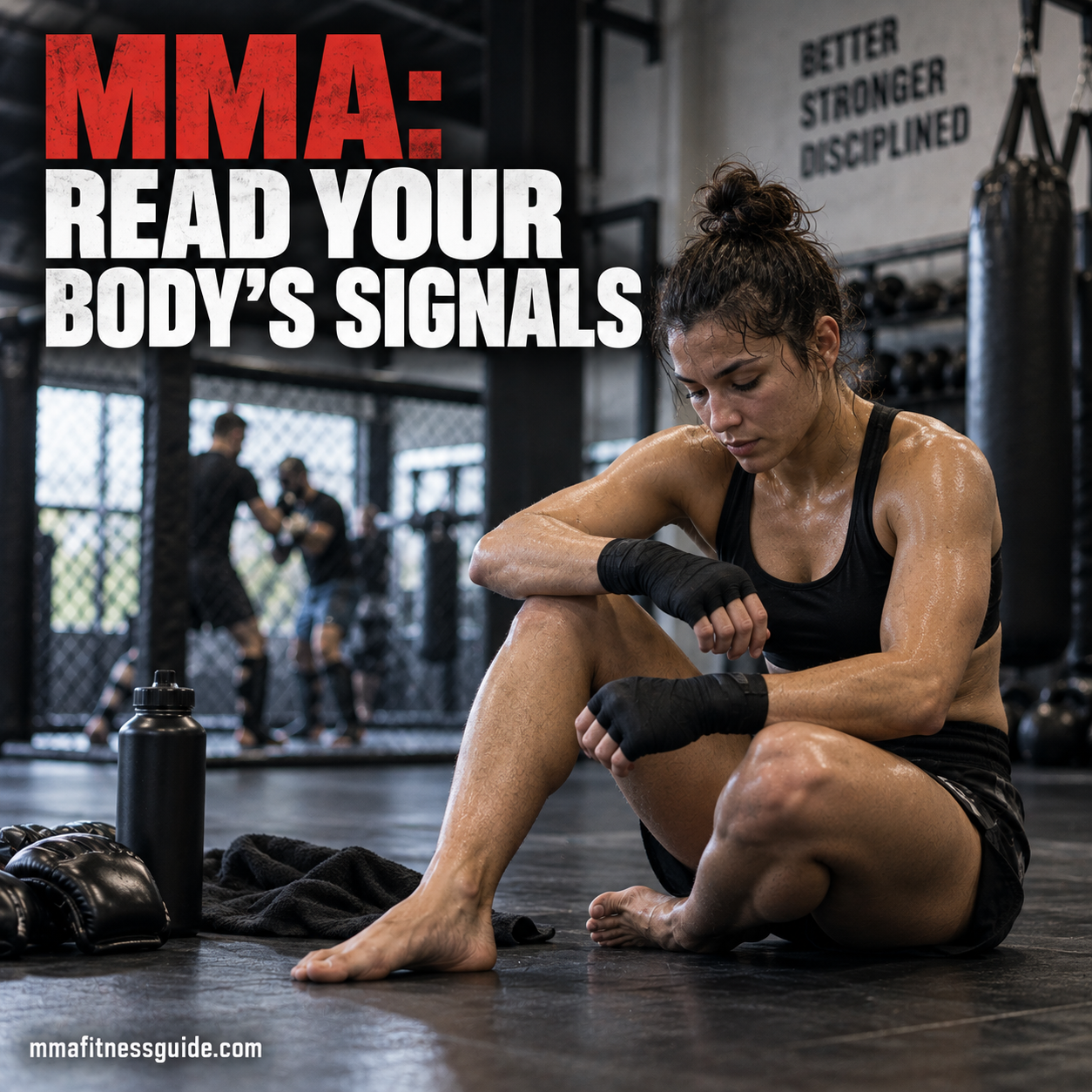
During MMA training, your breathing gets heavier, muscles tighten, reactions slow, and unfamiliar aches can appear. Some of those sensations are a normal part of adapting to training. Others are signs that it’s time to reduce the intensity or stop.
For beginners, telling the difference can be difficult. A hard conditioning round may leave your legs burning without anything being wrong, while a sudden pain in your knee during a takedown drill deserves a very different response.
Learning these differences helps you decide when to keep working, when to recover, and when a physical warning shouldn’t be ignored.
Why Beginners Struggle to Read Their Body
MMA exposes beginners to movements and physical demands they may not have experienced before. Grappling can leave unfamiliar muscles sore, striking drills can fatigue the shoulders, and repeated rounds can challenge both conditioning and concentration.
New fighters may:
- Keep training after their technique has deteriorated
- Ignore pain because they assume MMA is supposed to hurt
- Mistake ordinary post-training soreness for an injury
- Push through exhaustion when recovery would be more productive
- Become concerned about unfamiliar but normal training sensations
- Have difficulty judging how hard they can safely work
These distinctions become easier to recognize as you accumulate training experience and pay attention to how your body responds.
Key Body Signals Every Beginner Should Know
Your muscles, joints, breathing, coordination, and concentration can all provide useful information during training. Instead of judging a session only by how tired you feel, pay attention to how those signals change as the workout progresses.
Training Soreness vs. Possible Injury Pain
Muscle soreness commonly appears after introducing new exercises, increasing training volume, or using muscles differently than usual.
Typical muscle soreness may feel like:
- Tight or tender muscles
- Dull, widespread discomfort
- Stiffness after training
- Discomfort when using the affected muscles
- Soreness that gradually improves over the following days
Delayed-onset muscle soreness can also be more noticeable a day or two after a demanding workout.
Pain that deserves more caution may include:
- Sudden or sharp pain
- Pain concentrated around one specific area
- Pain that becomes worse as you continue moving
- Significant swelling
- Joint instability
- Difficulty bearing weight or using the affected area normally
Don’t use pain tolerance as a test of toughness. If a movement produces sudden or significant pain, stop performing it and assess what is happening. Persistent or severe symptoms should be evaluated by an appropriate healthcare professional.
Pay Attention to Your Breathing
Breathing changes quickly as training intensity increases, making it a useful indicator of how hard you’re working.
Heavy but controlled breathing
During pads, bag work, grappling, or conditioning, breathing heavily is expected. If you can still control your movements and recover during a short break, you may simply be working at a challenging intensity.
Ragged or uncontrolled breathing
If you’re gasping, holding your breath during exchanges, or losing your composure because you’re exhausted, reduce your pace. Concentrate on steady breathing and give yourself enough time to recover before increasing the intensity again.
Chest pain, unusual tightness, or light-headedness
Stop exercising rather than trying to push through these symptoms. Seek medical attention when symptoms are severe, persistent, or concerning.
Recognize When Fatigue Starts Affecting Technique
Being tired isn’t automatically a reason to stop. The more useful question is whether fatigue is changing the way you move.
Normal training fatigue can include:
- Tired muscles
- Reduced power
- A slower pace
- Heavier breathing
- Increasing effort as a round continues
You may still be able to train effectively if your movements remain controlled.
Warning signs of excessive fatigue include:
- Hands repeatedly dropping during striking
- Wobbly or uncoordinated footwork
- Poor posture
- Delayed reactions
- Sloppy takedown entries
- Difficulty following your coach’s instructions
- Losing awareness of what your partner is doing
Once fatigue significantly affects coordination and decision-making, adding more intensity may only produce poor repetitions and increase the chance of getting hurt.
Listen to Your Joints
MMA places substantial demands on the knees, shoulders, elbows, wrists, hips, and ankles. Grappling and wrestling can also place joints in positions that beginners aren’t accustomed to.
Some pressure and muscular tension can occur during normal training, but joint pain shouldn’t simply be accepted as part of MMA.
Pay closer attention to:
- Sharp joint pain
- Painful clicking or popping
- Buckling or instability
- Swelling
- Sudden loss of normal movement
- Pain around the knee, shoulder, elbow, wrist, or ankle that worsens during training
Stop the movement if a joint suddenly hurts. During submissions, tap before a joint reaches its limit rather than waiting to see how much pressure you can tolerate.
Your Mental State Can Signal Fatigue
Physical exhaustion doesn’t only affect your muscles. It can change concentration, reaction time, patience, and decision-making.
Signs you’re still mentally engaged include:
- Following instructions clearly
- Staying aware of your partner
- Remaining composed when tired
- Making deliberate technical decisions
Signs you may need a break include:
- Repeatedly forgetting instructions
- Losing track of what you’re doing
- Becoming unusually frustrated
- Making careless decisions
- Feeling mentally disconnected from the round
This becomes especially relevant during sparring and live grappling, where poor decisions affect both you and your training partner.
How to Respond to Your Body’s Signals
Recognizing a signal only helps if you change your training appropriately.
When you’re sore
Give yourself a thorough warm-up and see how your body responds. A lighter technical session may be more appropriate than another hard conditioning workout.
When you experience sharp pain
Stop the movement that caused it. Don’t repeatedly reproduce the movement just to see whether it still hurts.
When your breathing becomes uncontrolled
Reduce the pace and allow your breathing to settle. During technical work, prioritize clean movements instead of racing through repetitions.
When technique starts falling apart
Take a short recovery period or reduce the intensity. Five controlled repetitions are usually more useful than twenty exhausted ones performed with poor mechanics.
When you’re mentally overloaded
Simplify the session. Work on one technique, drill at a slower pace, or take a short break before returning.
Training Habits That Improve Body Awareness
You can become better at recognizing patterns in how your body responds to MMA training.
Keep a short training journal
You don’t need to document every detail. Record useful observations such as:
- How hard the session felt
- Areas that became unusually sore
- Any movements that caused discomfort
- How you slept the previous night
- Whether your performance improved or declined
Patterns become easier to recognize after several weeks.
Warm Up Before Increasing Intensity
A gradual warm-up gives you an opportunity to assess how your body feels before hard training begins.
Pay attention to stiffness, range of motion, coordination, and any discomfort that doesn’t improve as you move.
Use the Cooldown as a Check-In
After training, notice which muscles feel fatigued and whether any particular movement produces discomfort.
This gives you a baseline for comparing how you feel later that evening and the following day.
Track Sleep and Hydration
A poor session isn’t always caused by your MMA training. Lack of sleep, inadequate food, dehydration, stress, and accumulated fatigue can all affect performance.
If several sessions suddenly feel harder than normal, consider what has been happening outside the gym as well.
When to Push and When to Pull Back
Training hard and training recklessly aren’t the same thing.
You may be able to keep working when:
- You’re tired but coordinated
- Your breathing remains manageable
- Your technique is still controlled
- You understand and follow instructions
- The discomfort is ordinary muscular fatigue
Reduce the intensity or stop when:
- Your form repeatedly breaks down
- You develop sudden or sharp pain
- A joint feels unstable
- You become dizzy or unusually light-headed
- You can’t concentrate on your partner or technique
- Continuing no longer feels safe
The goal isn’t to avoid discomfort. MMA training is physically demanding. The goal is to recognize when productive discomfort has crossed into a situation where continuing no longer benefits the session.
Final Takeaway
A burning set of shoulders during pad work, tired legs late in a conditioning round, and muscle soreness the next morning can all be normal parts of MMA training. Sharp joint pain, instability, dizziness, or technique deteriorating to the point that you can’t move safely are different signals.
As you gain experience, you’ll become better at recognizing how your body normally responds to striking, grappling, conditioning, and recovery. Pay attention to those patterns instead of automatically pushing harder or stopping whenever training becomes uncomfortable.
The better you understand your normal responses, the easier it becomes to make sensible decisions about when to continue, reduce the intensity, recover, or get a problem checked.