After the final round, it’s tempting to take off your gloves, grab your water bottle, and head straight for the door. But your heart may still be racing, your shoulders and hips are tight, and your breathing hasn’t fully settled from the last few minutes of work.
Spending another five to ten minutes walking, breathing slowly, and moving through a few comfortable stretches gives your body a gradual transition from hard training back toward rest.
For MMA beginners, that short period is also a useful check-in. Once the intensity drops, you can notice which muscles feel unusually tight, whether anything hurts, and how well your breathing and heart rate are settling before you leave the gym.
Why Cooldowns Matter
During training, your heart rate spikes, your muscles tense, and your nervous system goes into “fight mode.”
A cooldown reverses that process.
Cooldowns help:
- Reduce muscle soreness
- Improve flexibility and mobility
- Lower stress hormones
- Prevent dizziness and blood pooling
- Speed up recovery between sessions
- Improve sleep and overall energy
- Extend training longevity
Skipping your cooldown may save 5 minutes today — but it slows progress tomorrow.
The Best Beginner Cooldowns for Faster Recovery
Each section includes simple movements you can perform right after training.
1. Light Movement (2–3 Minutes)
Before you stretch, gradually bring the heart rate down.
Try:
- Slow walking around the gym
- Slow jump-rope (very light)
- Gentle shadowboxing flow
- Marching in place
This prevents dizziness and helps flush out metabolic waste.
2. Deep Breathing Reset (30–60 Seconds)
Your cooldown should transition you from “fight mode” to “recovery mode.”
Try this simple pattern:
4 seconds inhale → 6 seconds exhale
Benefits:
- Lowers heart rate
- Helps the body relax
- Reduces mental tension
- Improves recovery after hard sessions
This is especially helpful after sparring or intense conditioning.
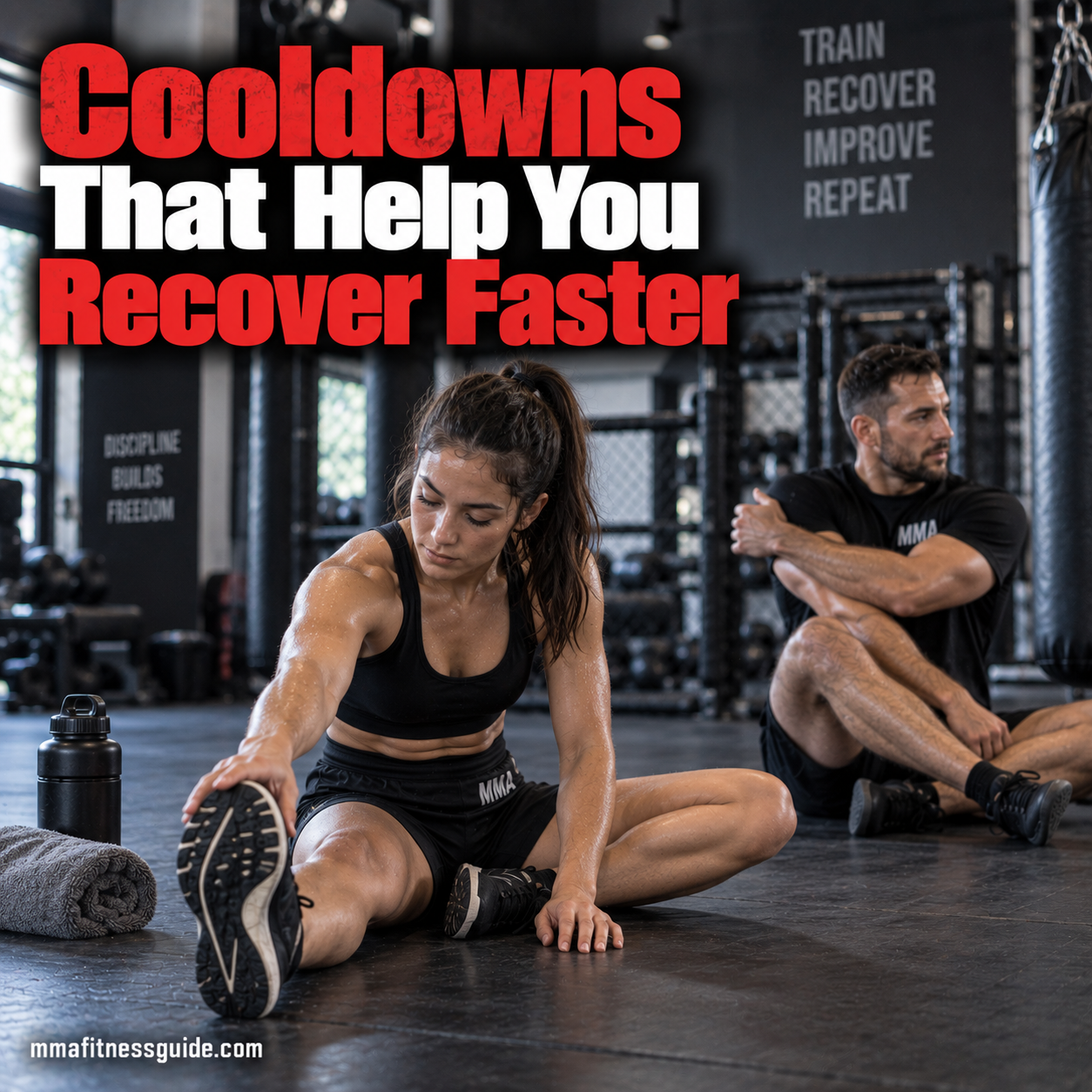
3. Lower-Body Stretching (2–3 Minutes)
MMA and fitness training heavily tax the legs and hips.
Hamstring Stretch
Hold 20–30 seconds each side.
Quad Stretch
Hold 20–30 seconds each side.
Hip Flexor Stretch
Step into a lunge and drive hips forward.
Calf Stretch
Press heel into the ground for 20–30 seconds.
These reduce tightness and improve mobility.
4. Upper-Body Stretching (1–2 Minutes)
Great after striking, grappling, or strength work.
Shoulder Cross-Body Stretch
Pull arm across chest gently.
Chest Wall Stretch
Place hand on wall and rotate away.
Triceps Stretch
Reach one arm overhead and bend at the elbow.
These help improve posture and reduce rounded-shoulder tightness.
5. Spine Mobility Cooldown (1–2 Minutes)
A flexible spine improves striking, grappling, and breathing.
Try:
Cat–Cow Flow
Move slowly for 5–8 reps.
Lumbar Rotations
Drop knees side to side while lying on your back.
Seated Torso Twist
Hold 20 seconds each side.
These movements release tension and reset your back.
6. Floor-Based Relaxation (1 Minute)
Finish with a simple grounding exercise.
Lay on your back
- Legs extended
- Palms up
- Slow nasal breathing
This signals the body that training is complete.
It also improves recovery by shifting your nervous system into rest-and-digest mode.
Extra Recovery Boosters (Optional)
These aren’t required — but they accelerate recovery even more:
- Foam rolling (slow and gentle)
- Light massage gun work
- Cold shower or contrast shower
- Protein + carbs within 60 minutes
- Hydration + electrolytes
- Short walk later in the day
Beginners often underestimate how powerful small recovery habits are.
How Long Should a Cooldown Be?
For beginners:
- Minimum: 3–5 minutes
- Ideal: 6–10 minutes
- Hard training days: up to 12 minutes
Even the shortest cooldown is better than none.
Final Takeaway
The cooldown is one of the simplest and most effective habits to speed up recovery — especially for beginners learning how their body responds to MMA training and fitness workouts. When you end each session with breathing, stretching, and light movement, your body feels better, your progress improves, and you reduce your risk of injury.
Cooldown consistently → recover faster → train harder tomorrow.