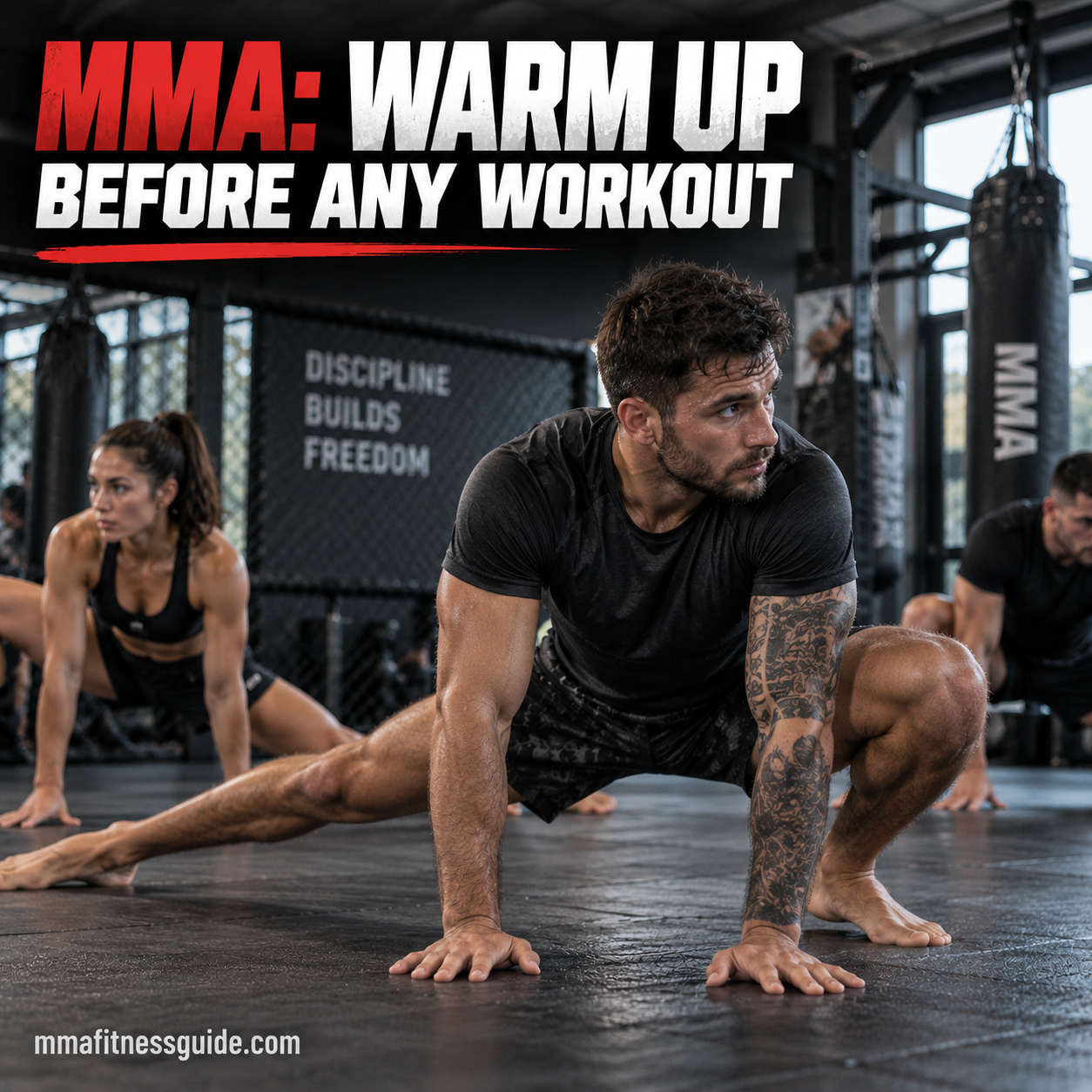
A proper warm-up sets up everything that follows in an MMA session, yet it’s often the first thing beginners skip when they’re short on time.
Whether you’re hitting pads, lifting weights, drilling takedowns, practicing Brazilian jiu-jitsu, or completing a conditioning circuit, your body needs time to transition from everyday activity into demanding exercise.
Mixed martial arts places significant demands on your shoulders, hips, knees, ankles, and spine. A single training session might involve throwing punches, rotating through kicks, changing levels for takedowns, and repeatedly getting up from the ground.
Going directly from sitting at a desk to performing explosive movements isn’t an ideal way to prepare for those demands.
A structured MMA warm-up gradually raises your heart rate, increases muscle temperature, moves your joints through comfortable ranges of motion, and introduces the movement patterns you’ll use during training.
It can improve readiness and performance and may contribute to injury prevention as part of a broader training program. However, warming up cannot eliminate injury risk, particularly in contact sports.
The good news is that beginners don’t need an elaborate routine.
A well-designed 5–10-minute warm-up can prepare you for most general MMA workouts. Hard sparring, heavy lifting, and particularly demanding sessions may require additional preparation.
This guide explains why warming up matters, provides a complete beginner routine, and shows you how to adjust your preparation for striking, grappling, strength training, and conditioning.
Why Warming Up Matters in MMA
MMA combines several athletic demands that rarely occur together in conventional fitness workouts.
During a striking session, you might rotate your hips repeatedly, pivot on your feet, extend your shoulders, and rapidly change direction.
During wrestling, you may lower your center of gravity, drive through your legs, resist an opponent’s weight, and transition between standing and ground positions.
Grappling introduces additional demands involving the neck, shoulders, hips, and trunk.
A proper warm-up prepares you for these movements by gradually increasing physical intensity.
1. Increases Muscle Temperature and Blood Flow
Light physical activity increases muscle temperature and circulation.
As your body becomes warmer, muscle contraction and movement can become more efficient.
Jogging, marching, skipping rope, and controlled jumping jacks are simple ways to begin this process.
The objective isn’t to exhaust yourself. You only need enough movement to feel warmer and notice a modest increase in breathing.
2. Improves Movement Readiness
MMA requires mobility through several joints.
Your hips must rotate during kicks, your ankles must accommodate changes in stance, and your shoulders need sufficient movement for punching and grappling.
Controlled mobility exercises help you explore these ranges before introducing greater speed or resistance.
For example, leg swings can prepare the hips for kicking, while shoulder circles and arm swings introduce movement before padwork.
3. Supports Better Training Performance
A progressive warm-up can improve readiness for explosive efforts, strength exercises, and technical drills.
Consider a heavy squat session.
Performing several progressively heavier preparation sets gives your body an opportunity to practice the movement before reaching demanding loads.
The same principle applies to striking.
Light shadowboxing allows you to rehearse punches and footwork before increasing speed and power.
4. May Help Reduce Injury Risk
Injury prevention is especially important in combat sports, where unexpected forces and contact are common.
A structured warm-up may help reduce certain injury risks, particularly when included in a broader program that develops strength, balance, technique, and appropriate training loads.
However, evidence varies between sports and warm-up protocols. A warm-up alone cannot guarantee protection against sprains, strains, or contact injuries.
5. Improves Mental Preparation
MMA training requires attention.
You need to recognize instructions, coordinate movement, respond to partners, and maintain awareness of your surroundings.
A warm-up provides a transition between daily activities and training.
Instead of immediately throwing full-power combinations, you can use several minutes to establish your stance, control your breathing, and focus on the upcoming session.
The Ultimate Beginner MMA Warm-Up (5–10 Minutes)
This routine is designed to prepare your entire body for a typical beginner MMA workout.
It follows five stages:
- Light movement.
- Joint mobility.
- Dynamic stretching.
- Muscle activation.
- MMA-specific movement.
The stages progress from general preparation toward movements that resemble your upcoming training.
The full version takes approximately eight to nine minutes. Shorten individual stages slightly when you only have five minutes, or extend the routine when preparing for more demanding exercise.
1. Light Movement (1 Minute)
Begin with low-intensity cardiovascular activity.
Your goal is to gradually increase your heart rate and muscle temperature without accumulating significant fatigue.
Choose one or combine several of the following movements.
Jogging in Place
Jog lightly while maintaining an upright posture.
Keep your shoulders relaxed and allow your arms to swing naturally.
You don’t need to lift your knees excessively or sprint.
Light High Knees
Alternate lifting your knees toward hip height, or lower if necessary.
Begin slowly and increase the rhythm as you become comfortable.
This introduces hip flexion while increasing cardiovascular demand.
Fast Marching
Fast marching is an excellent alternative for beginners who find jogging uncomfortable.
Drive your arms naturally and maintain a steady rhythm.
It also works well when training in an apartment where jumping may disturb neighbors.
Low-Intensity Jumping Jacks
Move your arms and legs together in a controlled rhythm.
If jumping is uncomfortable, step one foot outward at a time while raising your arms.
One-minute example:
- 20 seconds of jogging in place.
- 20 seconds of fast marching.
- 20 seconds of jumping jacks.
By the end, you should feel slightly warmer but still be able to speak comfortably.
For athletes who prefer gentler movement, our guide to low-impact conditioning for joint fitness explores additional exercise options.
2. Joint Mobility Flow (2 Minutes)
After increasing your body temperature, move through the major joints involved in MMA.
Mobility exercises involve actively moving a joint through a comfortable range of motion.
The objective is to improve movement readiness, not force your body into extreme positions.
Neck Mobility
The neck experiences significant demands during wrestling, clinching, and grappling.
Begin with gentle movements:
- Turn your head slowly from left to right.
- Tilt your ear toward each shoulder.
- Perform small, controlled nodding movements.
Avoid aggressive full neck circles, forceful stretching, or pushing your head into painful positions.
If you have a history of neck injury or experience dizziness, numbness, or pain, seek appropriate medical guidance before performing neck exercises.
Shoulder Circles
Perform small forward circles and gradually increase their size.
Repeat backward.
Keep your movements smooth rather than throwing your arms around aggressively.
Complete approximately five to ten circles in each direction.
Arm Swings
Swing your arms forward and backward through a comfortable range.
You can also open your arms outward before bringing them across your chest.
This introduces movement through the shoulders and upper back before punching or grappling.
Hip Circles
Stand with your feet approximately shoulder-width apart.
Place your hands on your hips and make controlled circles.
Perform five circles in each direction.
Keep the movement comfortable and avoid excessively arching your lower back.
Knee Mobility
Stand with your feet approximately hip-width apart and bend and straighten your knees gently.
You can also perform small, controlled mini-squats.
Avoid forcing your knees through large twisting circles.
Ankle Mobility
Lift one foot slightly and perform controlled ankle circles.
Alternatively, keep your foot planted and gently move your knee forward over your toes while maintaining heel contact.
Repeat on both sides.
Ankle mobility is particularly relevant to footwork, squatting, and changing levels.
For a more detailed routine, read how to warm up your joints before MMA sparring .
3. Dynamic Stretching (2 Minutes)
Dynamic stretching involves moving muscles and joints through controlled ranges rather than holding a position for an extended period.
It is particularly useful before MMA because it introduces movement while gradually increasing range of motion.
Unlike prolonged static stretching, appropriately performed dynamic stretching can prepare athletes for explosive exercise without unnecessarily reducing immediate force production.
Front-to-Back Leg Swings
Stand beside a wall or stable support.
Swing one leg forward and backward while maintaining control through your torso.
Begin with a small movement and gradually increase the range.
Perform approximately ten swings per leg.
This introduces movement through the hip flexors, hamstrings, and glutes.
Side-to-Side Leg Swings
Face a wall or stable support.
Swing one leg gently across your body and outward.
Keep your hips reasonably stable.
Perform ten repetitions on each side.
This movement is particularly useful before kicking sessions.
Walking Lunges
Step forward and lower into a controlled lunge.
Push through your front foot and bring your rear leg forward into the next repetition.
Perform approximately five lunges per leg.
Maintain balance and avoid rushing.
Torso Twists
Stand with your feet shoulder-width apart and rotate your torso gently from side to side.
Allow your arms to follow naturally.
Gradually increase the movement without forcing your spine into an extreme rotation.
Toe Touches Into Reach-Ups
Stand upright, hinge at your hips, and reach toward your toes as far as comfortable.
Return to standing and reach your arms overhead.
Repeat five to eight times.
Keep your knees slightly bent if needed.
Important: Dynamic stretching should feel controlled and comfortable. Painful stretching, bouncing aggressively into end ranges, and forcing high kicks before you’re ready are unnecessary.
For a broader selection of movements, explore our guide to dynamic warm-ups for combat performance .
4. Activation Drills (2 Minutes)
Activation drills introduce low-intensity muscular work before more demanding exercises.
The goal is to practice engaging important muscle groups and maintaining stable positions.
You don’t need to exhaust your muscles or create a burning sensation.
For MMA, useful areas to address include the glutes, core, and shoulders.
Glute Activation: Glute Bridges
The glutes contribute to hip extension, lower-body force production, and pelvic control.
They are involved in movements such as standing from a low position, driving through takedowns, and extending the hips.
How to perform glute bridges:
- Lie on your back with your knees bent.
- Place your feet flat on the floor.
- Tighten your abdominal muscles.
- Push through your feet and lift your hips.
- Pause briefly before lowering.
Perform 10–15 repetitions.
Avoid excessively arching your lower back at the top.
Core Activation: Dead Bugs
Dead bugs challenge your ability to maintain trunk stability while moving your arms and legs.
Lie on your back with your arms extended upward and your knees bent above your hips.
Slowly extend one arm and the opposite leg while maintaining control through your torso.
Return to the starting position and alternate sides.
Perform approximately five repetitions per side.
Alternative: Slow Mountain Climbers
Begin in a high plank.
Bring one knee toward your chest, return it, and alternate legs.
Keep your hips relatively stable.
Continue for 20–30 seconds.
Shoulder Stability: Scapular Push-Ups
Begin in a high plank or use a wall for an easier variation.
Keep your elbows straight while allowing your shoulder blades to move together slightly.
Then push the floor away, allowing your shoulder blades to spread apart.
Perform 10–15 controlled repetitions.
This movement trains control around the shoulder blades, which contributes to healthy shoulder mechanics.
Alternative: Band Pull-Aparts
Hold a light resistance band in front of your chest.
Pull your hands apart while maintaining control through your shoulders.
Return slowly.
Complete 10–15 repetitions.
These exercises strengthen and coordinate muscles involved in supporting the shoulders, trunk, and hips. They are useful preparation tools, but they do not guarantee protection against knee, spine, shoulder, or rib injuries.
5. MMA-Specific Warm-Up (1–2 Minutes)
The final stage connects your general preparation to the movements you’ll perform during training.
This is where the warm-up becomes specific to mixed martial arts.
You should already feel warmer and more mobile.
Now introduce technical movements at a controlled pace.
Light Shadowboxing (30–60 Seconds)
Begin in your fighting stance.
Throw simple combinations such as:
- Jab–cross.
- Jab–cross–hook.
- Jab followed by a defensive movement.
Focus on balance, hip rotation, and returning your hands to position.
Avoid throwing maximum-power punches.
Your goal is to rehearse movement rather than test your conditioning.
Footwork Steps (30 Seconds)
Move forward, backward, left, and right.
Maintain your stance and avoid crossing your feet unnecessarily.
Practice stopping in a balanced position after each movement.
Begin slowly before increasing the pace.
Technical Movements (30–60 Seconds)
Choose one movement based on your upcoming session.
Slow sprawls: Practice moving your legs backward into a controlled defensive position.
Hip escapes: Perform shrimping movements to rehearse hip movement used in grappling.
Knee chambering: Lift your knee into position without throwing a powerful strike.
Light kicks: Practice controlled kicks with an emphasis on balance and proper technique.
Beginners should avoid explosive sprawls or high kicks until they have sufficient movement control.
If your next workout involves wrestling, select sprawls or hip escapes.
If you’re preparing for striking, choose shadowboxing, footwork, or controlled kicks.
This principle—moving from general preparation to specific movement—is what makes a warm-up relevant to the activity that follows.
How to Adjust Your Warm-Up for Different MMA Workouts
The basic routine works before most training sessions, but different activities require different preparation.
A heavy strength workout places different demands on the body than a Brazilian jiu-jitsu class.
The most effective approach is to retain the general warm-up and add several minutes of relevant movement.
Before Striking and Padwork
Emphasize:
- Shoulder circles and arm swings.
- Hip rotation and leg swings.
- Ankle mobility.
- Light shadowboxing.
- Gradually increasing punching combinations.
Begin padwork with controlled punches before increasing power.
For kicking sessions, progressively increase kick height and speed rather than immediately attempting your highest or hardest kicks.
Before Wrestling and Grappling
Emphasize:
- Gentle neck mobility.
- Shoulder movement.
- Hip circles.
- Controlled squats and lunges.
- Hip escapes.
- Technical stand-ups.
- Slow sprawls.
Introduce partner resistance gradually.
Begin with cooperative drills before moving toward more demanding positional work.
Avoid aggressive neck bridges or high-impact movements as a general beginner warm-up.
Before Strength Training
Complete the general warm-up, then perform preparation sets for your main exercise.
For example, before heavy squats:
- Perform controlled bodyweight squats.
- Complete a light squat set.
- Increase the resistance gradually.
- Begin your working sets when movement feels comfortable and controlled.
The same approach applies to deadlifts, presses, and other major lifts.
A general warm-up does not replace exercise-specific preparation for heavy lifting.
Before Conditioning Workouts
Begin with light cardiovascular movement and gradually increase intensity.
If your workout includes burpees, practice several slow repetitions first.
If you’re preparing for sprint intervals, begin with walking, easy jogging, and progressively faster running.
Avoid starting a maximal-effort interval directly from rest.
For additional beginner-friendly sessions, explore our MMA workouts you can start at home .
Optional Extended Warm-Up (Extra 3–5 Minutes)
Some training sessions benefit from additional preparation.
You might need more time after spending several hours sitting, training in a cold environment, or preparing for particularly demanding activity.
The following options can extend your routine.
Foam Rolling
Use a foam roller on areas such as your quadriceps, calves, and upper back.
Move slowly and avoid applying excessive pressure.
Foam rolling may temporarily improve range of motion or reduce the sensation of stiffness, but it isn’t necessary for everyone.
Avoid rolling directly over painful injuries or aggressively applying pressure to your lower back.
Mini-Band Lateral Walks
Place a light resistance band around your thighs or ankles.
Bend your knees slightly and take controlled sideways steps.
Maintain tension on the band without allowing your knees to collapse inward.
Perform approximately ten steps in each direction.
Light Rope Skipping
Skip rope at a comfortable pace for one minute.
Keep your jumps low and land softly.
If jumping causes discomfort, substitute marching or another low-impact movement.
Use these additions when they address a specific need rather than automatically making every warm-up longer.
Common MMA Warm-Up Mistakes to Avoid
A warm-up can become ineffective when it’s rushed, excessively intense, or unrelated to the upcoming workout.
Beginners should pay particular attention to the following mistakes.
1. Holding Long Static Stretches Immediately Before Explosive Training
Static stretching involves holding a muscle in a lengthened position.
It can be useful for developing flexibility, but prolonged static stretching immediately before explosive activity may temporarily reduce performance in some circumstances.
Short, comfortable static stretches aren’t automatically harmful. However, dynamic movement is generally a practical priority before MMA.
Save longer flexibility sessions for separate training periods or after workouts when appropriate.
2. Turning the Warm-Up Into a Conditioning Workout
Your warm-up shouldn’t leave you gasping for air.
Performing dozens of burpees, repeated sprints, or exhausting circuits before technical training may reduce the quality of your main session.
Increase intensity gradually and preserve energy for the workout itself.
3. Skipping Warm-Ups on Easy Days
Even a light technical session involves repeated movement.
A shorter warm-up may be sufficient, but going directly into kicks, takedowns, or other demanding movements without preparation is unnecessary.
4. Only Preparing One Part of the Body
Shadowboxing alone may not adequately prepare your hips and legs for wrestling.
Likewise, jogging alone doesn’t specifically prepare your shoulders for grappling.
Use a whole-body foundation before emphasizing the areas most relevant to your session.
5. Jumping Straight Into Sparring
Sparring introduces unpredictable movement and contact.
Begin with general preparation, technical drills, and progressively more demanding movement.
Your warm-up should prepare you physically and technically before live exchanges begin.
How Long Should an MMA Warm-Up Be?
Warm-up duration depends on the session, your training experience, and how quickly you feel prepared.
The following ranges provide practical starting points.
| Training Situation | Suggested Duration |
|---|---|
| Short beginner workout | 5–7 minutes |
| General MMA training | 8–12 minutes |
| Hard training or sparring | 10–15 minutes or longer as needed |
| Heavy strength training | General warm-up plus progressive preparation sets |
These are guidelines rather than strict requirements.
A five-minute warm-up may be sufficient before a light home workout but inadequate before demanding sparring.
How Do You Know You’re Warmed Up?
Look for several signs:
- Your body feels noticeably warmer.
- Your breathing has increased slightly.
- Your joints move comfortably.
- You can perform the upcoming movements with control.
- You feel mentally focused.
- You aren’t significantly fatigued.
Sweating isn’t a reliable requirement. Temperature, humidity, and individual differences affect how quickly people sweat.
The goal is readiness, not exhaustion.
Should You Stretch Before or After MMA Training?
Stretching serves different purposes depending on when and how it’s performed.
Before training, dynamic movements are generally useful for preparing the body for exercise.
After training, static stretching may be included to work on flexibility or address areas that feel restricted.
However, stretching after exercise doesn’t reliably prevent delayed-onset muscle soreness, and it shouldn’t be treated as a guaranteed injury-prevention method.
Before Training
Prioritize:
- Controlled leg swings.
- Walking lunges.
- Arm swings.
- Hip mobility.
- Progressive technical movements.
After Training
Consider comfortable static stretches targeting the muscles used during the session.
Hold each position without bouncing or forcing painful ranges.
For a more detailed approach, read our guide to stretching routines that keep fighters flexible .
Warm-Up Tips for Better MMA Performance
A good warm-up should become a consistent part of your training routine.
The following habits make preparation more effective.
Start gradually. Begin with easy movement before introducing faster or more demanding exercises.
Control your breathing. Comfortable nasal breathing may help you maintain a relaxed pace early in the warm-up, but breathe through your mouth when necessary.
Move smoothly. Avoid jerking your joints or forcing uncomfortable ranges of motion.
Prepare the movements you’ll use. A grappling session should include relevant hip and ground movements, while a striking session should emphasize footwork and controlled combinations.
Pay attention to discomfort. Sharp pain, unusual dizziness, or persistent joint discomfort shouldn’t be ignored.
Avoid unnecessary fatigue. Your warm-up should improve readiness for the main workout.
Develop a repeatable routine. Consistency makes it easier to identify which movements help you feel prepared.
For beginners building a complete training schedule, our weekly MMA workout plan for absolute beginners provides a broader structure for organizing sessions.
Frequently Asked Questions About MMA Warm-Ups
Is a Five-Minute Warm-Up Enough for MMA?
Five minutes may be enough before a light beginner workout, particularly if the session begins at a low intensity.
Hard sparring, heavy lifting, and demanding conditioning usually benefit from additional preparation.
Adjust the duration based on the upcoming activity rather than following a fixed time regardless of circumstances.
Should You Warm Up Before Shadowboxing?
Yes, particularly if you intend to shadowbox at a high intensity.
However, slow and controlled shadowboxing can also form part of the warm-up itself.
Begin with simple movements before increasing punching speed, footwork intensity, or kick height.
Are Jumping Jacks a Good MMA Warm-Up?
Jumping jacks are a convenient way to increase your heart rate and introduce whole-body movement.
They work well during the first stage of a warm-up.
However, they don’t replace mobility exercises or activity-specific preparation.
Should You Warm Up Before Brazilian Jiu-Jitsu?
Yes.
BJJ involves substantial demands on the hips, shoulders, neck, and trunk.
Begin with general movement and mobility before introducing controlled hip escapes, technical stand-ups, and partner drills.
Avoid high-resistance grappling before you’re adequately prepared.
Can a Warm-Up Prevent MMA Injuries?
A well-designed warm-up may contribute to injury prevention, but it cannot eliminate risk.
Technical instruction, appropriate training intensity, strength development, recovery, and responsible sparring practices are also important.
What Should You Do After an MMA Workout?
Gradually reduce your exercise intensity and allow your breathing to settle.
Light walking, gentle movement, and optional stretching can be included.
After particularly demanding sparring, prioritize hydration, nutrition, and sufficient recovery.
Our guide to the best warm-down techniques after intense sparring explores practical post-training options.
Warm-Up vs. Cooldown: Why Fighters Need Both
Warm-ups and cooldowns occur at opposite ends of a training session, but they serve different purposes.
A warm-up gradually increases activity and prepares your body for exercise.
A cooldown gradually reduces activity after training.
For example, a fighter might begin with light jogging, mobility drills, and shadowboxing before a padwork session.
Afterward, they might walk for several minutes, allow their breathing to return toward normal, and perform comfortable stretching.
Cooldowns may help provide a gradual transition out of intense exercise, but evidence that they substantially prevent soreness or accelerate recovery is limited.
Recovery also depends on adequate sleep, nutrition, hydration, and appropriate training loads.
For additional guidance, read our article on cooldowns that help you recover faster .
Final Takeaway: Warm Up Before Every MMA Workout
A proper MMA warm-up doesn’t need to be complicated, but it should be deliberate.
Begin with light cardiovascular movement to increase body temperature. Follow with controlled joint mobility, dynamic stretching, and activation exercises.
Finish by practicing movements that resemble your upcoming training session.
For beginners, five to ten minutes provides a practical starting point. Extend the routine when preparing for demanding sparring, heavy strength training, or particularly intense conditioning.
The goal isn’t to complete as many exercises as possible. It’s to arrive at your main workout feeling physically prepared, mentally focused, and capable of moving with control.
Make warming up a regular part of your training rather than something you only do when you have extra time.
Warm up with purpose, train with control, and build habits that support long-term MMA development.
Continue Building Your MMA Training Routine
A proper warm-up is only one part of a complete training program. Explore these related guides to improve your preparation, mobility, and recovery:
- Dynamic Warm-Ups for Combat Performance — Explore additional movement-based warm-up exercises for combat sports.
- How to Warm Up Your Joints Before MMA Sparring — Prepare your shoulders, hips, knees, and other joints for demanding training.
- Stretching Routines That Keep Fighters Flexible — Develop flexibility and maintain comfortable movement ranges.
- Best Warm-Down Techniques After Intense Sparring — Learn how to transition out of demanding training sessions.
- Weekly Workout Plan for Absolute Beginners — Organize your MMA workouts into a manageable weekly schedule.