Running can add useful aerobic conditioning to an MMA training schedule, but the first few weeks are where beginners often do too much too soon. A fighter who is already comfortable doing rounds on the mats may still have calves, shins, ankles, and knees that aren’t accustomed to repeated running impact.
Starting with three hard miles, adding sprints immediately, or running every day can turn a conditioning plan into sore shins or irritated knees before a routine has even formed.
A better starting point is deliberately easy: short runs, walking breaks, recovery days, and gradual increases in workload.
Why Running Can Help MMA Beginners
MMA rounds demand repeated bursts of activity followed by periods where you need to recover without completely stopping. Running can supplement sport-specific training by developing general cardiovascular endurance.
Depending on how you structure it, running can support:
- Aerobic conditioning
- Cardiovascular endurance
- Recovery between harder efforts
- Weight management
- General work capacity
- Mental tolerance for sustained effort
It won’t replace striking, wrestling, grappling, or MMA-specific conditioning. Think of it as another tool you can fit around those sessions.
1. Make Your First Runs Easier Than Your MMA Workouts
Your first runs aren’t fitness tests.
If you haven’t run regularly, begin at a pace where you aren’t fighting to finish. Your cardiovascular fitness may improve faster than your legs adapt to the repeated impact, so feeling capable of running farther doesn’t always mean you should.
For the first couple of weeks, emphasize:
- Easy jogging
- Run-walk intervals
- Short distances
- Recovery between runs
- Little or no high-intensity sprinting
Give your body time to become accustomed to the new workload before adding speed or distance.
2. Use Run-Walk Intervals
Walking breaks allow you to accumulate running time without forcing yourself to continuously jog once your form and coordination begin deteriorating.
A beginner progression could look like this:
Week 1
- Jog for 1 minute
- Walk for 1 minute
- Repeat for 10–12 rounds
Week 2
- Jog for 2 minutes
- Walk for 1 minute
- Repeat for 8–10 rounds
Week 3
- Jog for 3–4 minutes
- Walk for 1 minute
- Repeat for 6–8 rounds
These aren’t mandatory targets. If a week feels unusually difficult or you’re experiencing persistent discomfort, repeat the previous workload rather than automatically progressing.
3. Choose a Predictable Running Surface
Each surface changes the way running feels.
A track or treadmill can make pace and distance easy to control. A smooth trail may provide variety, while hills and technical trails introduce additional demands.
Beginners can experiment with:
- Running tracks
- Treadmills
- Flat roads or paths
- Smooth, predictable trails
Be more cautious initially with steep hills, highly uneven trails, or abrupt changes in terrain.
Softer isn’t automatically safer. What matters more is choosing a surface you can navigate comfortably and increasing your total running workload gradually.
4. Wear Running Shoes That Fit Properly
Price isn’t the deciding factor. A running shoe should fit your foot comfortably and remain comfortable once you’ve been moving for a while.
Look for:
- Enough room around the toes
- A secure heel
- Comfortable cushioning
- Appropriate width
- No rubbing or pressure points
Don’t assume that a specific shoe category will automatically correct your running mechanics. If you repeatedly experience foot or lower-leg problems, a qualified healthcare or sports professional can help determine whether footwear, training load, mechanics, or another factor may be contributing.
Running shoes also don’t have a universal expiration mileage. Replace them when wear, damage, or changes in comfort and performance indicate that they’re no longer working well for you.
5. Warm Up Before You Start Running
Going directly from sitting all day to running at a hard pace can make the first several minutes unnecessarily uncomfortable.
Spend a few minutes gradually increasing movement.
For example:
- 10 front-to-back leg swings per side
- 10 side-to-side leg swings per side
- Ankle circles
- 10 walking lunges
- 10–15 calf raises
- A few minutes of brisk walking
Then begin the run easily rather than immediately accelerating to your intended pace.
6. Avoid Reaching Too Far With Each Step
Beginners sometimes lengthen their stride when they want to run faster. Reaching excessively far in front of the body can make running feel heavier and less controlled.
Instead, concentrate on relaxed movement.
A useful cue is:
“Short, comfortable steps.”
Don’t force yourself to land on a particular part of your foot or chase a perfect running form based on a single cue. Your stride should feel natural and controlled rather than exaggerated.
7. Use Breathing to Judge Your Effort
Your breathing provides immediate feedback about running intensity.
During an easy run, you should generally feel like you’re working without repeatedly gasping for air. If your breathing suddenly becomes frantic and your pace wasn’t supposed to be hard, that’s a useful signal to slow down.
Some runners find nasal breathing useful as a pacing cue at lower intensities, but there’s no need to force yourself to breathe exclusively through your nose.
As the effort increases, breathing through both the nose and mouth is normal.
8. Leave Recovery Time Between Runs
Running every day isn’t necessary to improve your conditioning.
For many MMA beginners, two or three runs per week provide a reasonable starting structure because running has to fit alongside striking, grappling, strength work, and recovery.
For example:
- Monday: MMA training
- Tuesday: Easy run
- Wednesday: MMA training
- Thursday: Rest or light activity
- Friday: MMA training
- Saturday: Easy run
- Sunday: Rest
Your schedule should reflect how demanding your MMA sessions already are.
A beginner doing hard MMA classes four times per week has very different recovery needs from someone training twice per week.
9. Strengthen the Muscles Used During Running
Strength work can complement running by preparing the legs and trunk to tolerate training.
Useful exercises include:
- Calf raises
- Squats
- Split squats
- Hip bridges
- Side steps with a resistance band
- Planks
If you’re already strength training for MMA, you may already perform several of these movements.
The goal isn’t to add another exhausting workout. Add enough strength work to support your overall program without compromising recovery for MMA practice.
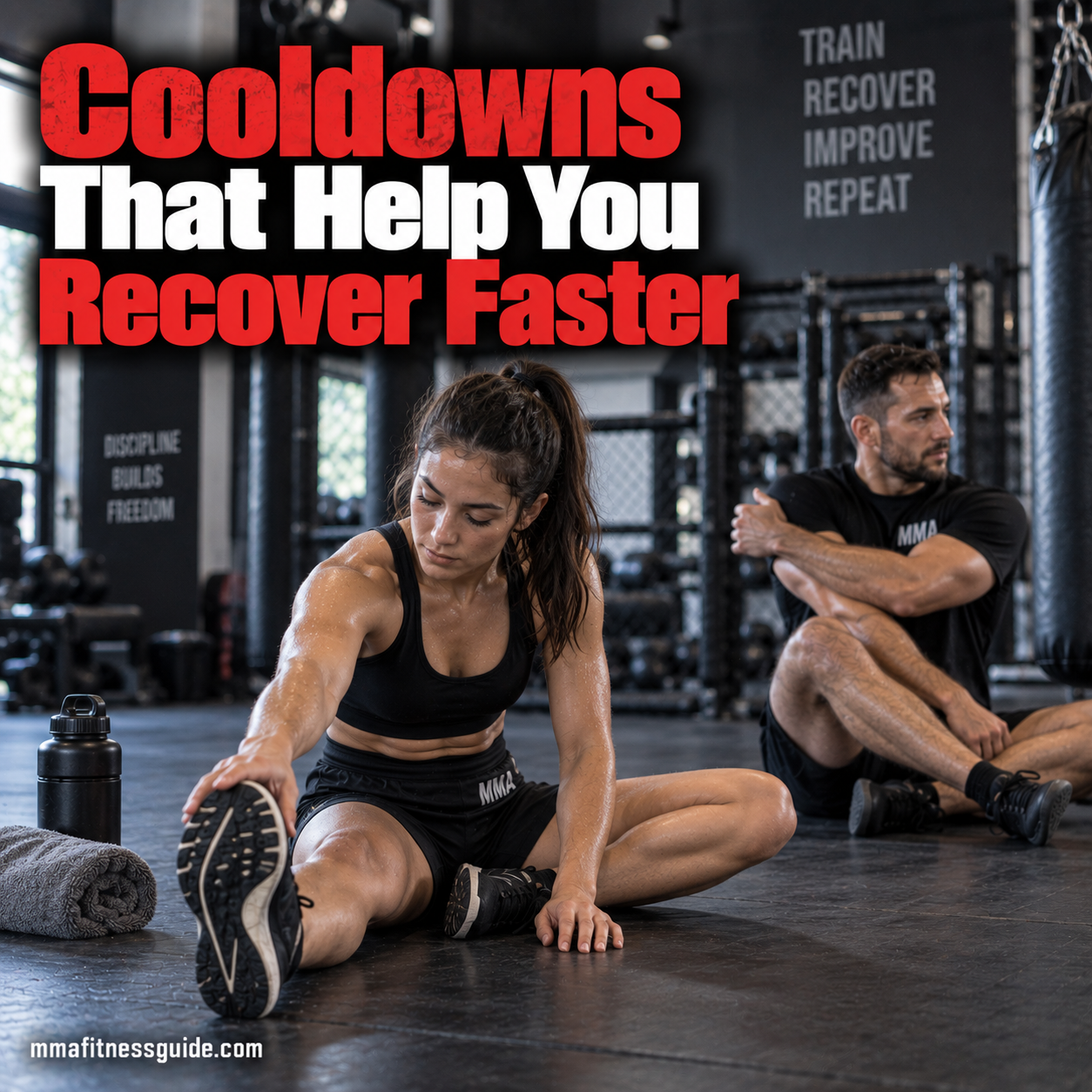
10. Cool Down Instead of Stopping Abruptly
After finishing a run, spend a few minutes walking and allowing your breathing and heart rate to settle gradually.
If stretching feels good, you can include gentle stretches for areas such as the:
- Calves
- Hip flexors
- Quadriceps
- Hamstrings
Stretching may help some people feel less stiff or maintain flexibility, but it shouldn’t be treated as a guarantee against running injuries.
Recovery also depends on your total training load, sleep, nutrition, and time between demanding sessions.
11. Pay Attention to Pain That Changes Your Movement
Some muscle fatigue and soreness can occur when you begin running, particularly if your body isn’t accustomed to it.
More concerning symptoms can include:
- Sudden or sharp pain
- Significant swelling
- Pain that becomes progressively worse during a run
- Numbness or unusual tingling
- Joint instability
- Pain that causes you to limp or change your stride
Don’t try to diagnose an injury based only on how the pain feels. Stop or reduce the activity when something feels wrong, and seek appropriate medical evaluation for severe, persistent, or worsening symptoms.
12. Earn Your Faster Running
Sprints, hills, and intervals place different demands on your body than easy running.
Build a comfortable running base first.
Once you’re consistently completing easy runs without problems, you can gradually introduce harder work such as:
- Short intervals
- Tempo efforts
- Hill runs
- Short sprints
Don’t add everything at once. Increasing distance, frequency, and intensity simultaneously makes it difficult to identify which change caused a problem if discomfort appears.
Introduce one new demand, see how your body responds, and progress from there.
How Running Fits Into MMA Conditioning
Running should support your MMA training rather than leave you too fatigued to perform it.
Easy aerobic runs can fit well between harder sessions, while sprints and intervals need to be treated as demanding conditioning workouts of their own.
If your legs are constantly exhausted during wrestling, your movement is deteriorating during striking practice, or you’re struggling to recover between sessions, your running volume may be competing with your MMA training rather than helping it.
Adjust accordingly.
Final Thoughts
Your first month of running doesn’t need impressive mileage or fast times. Completing two manageable runs each week without interfering with MMA practice is a better foundation than pushing through several hard runs and needing a week off afterward.
Start with easy running or run-walk intervals. Allow recovery between sessions. Once that workload feels normal, increase either the duration or intensity gradually.
The objective is simple: make running something your body can repeatedly recover from so it continues supporting your MMA training months from now.