Introduction
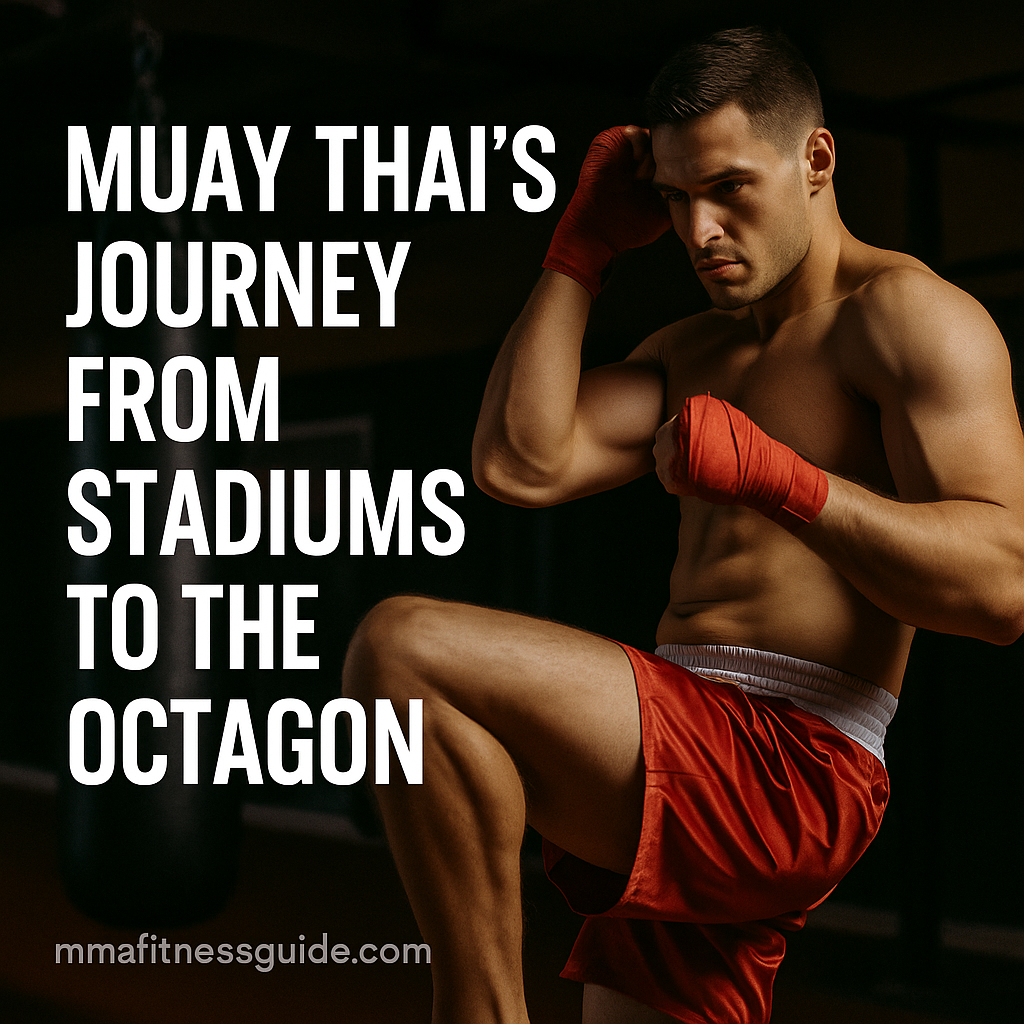
For decades, Muay Thai dominated Thailand’s stadiums as a national combat sport built on grit, strategy, and tradition. Today, it’s also one of the most influential striking bases in MMA. From razor-sharp elbows to devastating leg kicks, Muay Thai has shaped countless champions and changed how fighters strike in the cage.
Here’s how “The Art of Eight Limbs” went from Bangkok stadiums to the global stage — and eventually, into the Octagon.
Muay Thai’s Origins: Tradition, Culture, and Combat
Muay Thai began as Muay Boran, an ancient battlefield martial art used by Thai warriors. Over centuries, it evolved into a ring sport practiced across Thailand, eventually becoming:
- a national pastime
- a way for youth to support their families
- a respected combat tradition
- a technical and strategic sport
By the 20th century, Thailand had developed a massive stadium circuit — and it was here that modern Muay Thai took shape.
Stadium Legends and the Golden Era
Two stadiums defined elite-level Muay Thai:
Lumpinee Stadium
The Mecca of Muay Thai.
Champions here are considered the best in the world.
Rajadamnern Stadium
Historic, intense, and deeply respected.
These stadiums produced legends like:
- Samart Payakaroon
- Dieselnoi Chor Thanasukarn
- Somrak Khamsing
- Buakaw Banchamek (modern era)
During the 1980s–1990s — known as the Golden Era — Muay Thai reached its highest technical levels. Fighters displayed:
- flawless balance
- timing and feints
- powerful kicking
- strong clinch IQ
This era shaped the techniques now used in MMA striking.
The Global Spread of Muay Thai
As Thailand became a travel destination in the 2000s, foreigners began visiting camps to train. They brought Muay Thai home, helping it spread to:
- Europe
- the United States
- Australia
- Brazil
- Japan
International promotions like K-1 and ONE Championship showcased Muay Thai athletes on world stages. Fighters like Buakaw and Saenchai became global icons.
Soon, MMA gyms everywhere were teaching Muay Thai fundamentals because the techniques worked — and they worked exceptionally well.
Early MMA and the Need for Better Striking
When MMA exploded in the 2000s, most fighters came from:
- wrestling
- BJJ
- boxing
- karate
But as strikers entered the cage, it became clear:
Muay Thai blended seamlessly into MMA.
Why?
Because it provides:
- strong stance control
- devastating low kicks
- powerful clinch control
- knees and elbows
- balanced footwork
- efficient combinations
It was a perfect match for MMA’s pace and diversity.
Key Muay Thai Techniques That Dominated Early MMA
Muay Thai offered tools that changed MMA strategy forever.
Leg Kicks
Used to slow movement and destroy balance.
Examples:
- José Aldo
- Edson Barboza
Clinch Knees
Brutal in close range.
Examples:
- Anderson Silva
- Cris Cyborg
Elbows
High-damage, short-range weapons.
Examples:
- Jon Jones
- Tony Ferguson
Roundhouse Kicks
Long, powerful, and energy-efficient.
Examples:
- Valentina Shevchenko
- Mirko Cro Cop (hybrid kickboxing + Thai influence)
These tools helped early Muay Thai–based fighters dominate.
Muay Thai Specialists Who Shaped MMA
Several fighters reshaped the striking landscape by showing how effective Muay Thai could be:
Anderson Silva
Master of the Thai clinch and counterstriking.
José Aldo
Low kick destruction + beautiful balance.
Joanna Jędrzejczyk
Clinched, elbowed, and volume-struck her way to dominance.
Charles Oliveira (evolved style)
Integrates slick elbows and knees into his grappling-heavy approach.
Donald Cerrone
Showed the power of structured Muay Thai combinations.
Their success pushed gyms worldwide to incorporate Muay Thai into standard MMA training.
Modern Muay Thai for MMA: What’s Different?
Muay Thai for MMA isn’t identical to traditional stadium Muay Thai.
It’s adapted.
Stance Adjustments
MMA fighters keep a slightly lighter, more mobile stance to defend takedowns.
Modified Clinch
Less prolonged clinching — more quick strikes and off-balancing.
Cage Tactics
Using the fence to trap opponents for knees and elbows.
Shorter Rhythm
MMA rounds are shorter and faster-paced.
Defensive Modifications
More head movement than traditional Muay Thai requires.
The foundation remains the same — the execution evolves.
How Muay Thai Continues to Influence Today’s Fighters
Modern champions rely heavily on Muay Thai elements:
- Israel Adesanya
- Zhang Weili
- Dustin Poirier
- Max Holloway
- Justin Gaethje
Even fighters without a pure Thai background use its striking structures daily.
Muay Thai is no longer “one of many striking styles.”
It’s now a fundamental part of MMA training worldwide.
Final Thoughts
Muay Thai’s journey from Thailand’s stadiums to the Octagon is one of evolution, adaptation, and timeless effectiveness. The art’s power, balance, and simplicity turned it into one of the most dominant striking systems in combat sports.
Today, nearly every MMA fighter on the planet uses Muay Thai in some way — a testament to its impact, tradition, and staying power.
“The Art of Eight Limbs” has truly become the art of MMA striking.