Introduction
Mobility doesn’t require fancy equipment, long sessions, or extreme stretching. In fact, some of the most effective routines take just a few minutes and can be done anywhere. Whether you train MMA, work a desk job, or simply want to feel better throughout the day, mobility makes movement easier, smoother, and more comfortable.
These simple routines keep your joints healthy, reduce tightness, and help your body stay ready for training or everyday life.
Why Mobility Matters (Even If You’re Not Training Hard)
Mobility is your ability to move a joint freely and comfortably.
Good mobility helps:
- prevent injuries
- reduce stiffness
- improve posture
- increase range of motion
- make daily tasks easier
- support better technique in martial arts
Most stiffness comes from long hours of sitting, poor posture, or not moving enough. Mobility fixes that.
The Basics of a Good Mobility Routine
A solid, simple routine includes:
- Controlled movements
- Slow breathing
- Full ranges of motion
- Light muscle engagement
Your goal isn’t to push hard — it’s to move smoothly and consistently.
A Simple Daily Mobility Routine (10 Minutes)
Here is a beginner-friendly sequence that works for everyone. You can do it after waking up, before training, or before bed.
1. Neck Circles — 30 seconds
Gently rotate your head clockwise and counterclockwise.
Benefits:
- reduces neck tension
- improves posture
- eases desk-related stiffness
2. Shoulder Rolls — 30 seconds
Roll shoulders forward for 15 seconds and backward for 15 seconds.
Benefits:
- loosens upper traps
- reduces rounded-shoulder posture
- helps punching mechanics
3. Cat–Cow (Spine Mobility) — 1 minute
On hands and knees, alternate arching and rounding your back.
Benefits:
- improves spine movement
- reduces back stiffness
- great for people who sit all day
4. Thoracic Rotations — 1 minute
On all fours, open one arm toward the ceiling, twisting your upper back. Switch sides.
Benefits:
- increases rotational mobility
- helpful for grappling posture and striking mechanics
5. Hip Circles — 1 minute
Stand tall and draw circles with one knee, then switch.
Benefits:
- loosens hips
- prepares legs for movement
- reduces tightness from sitting
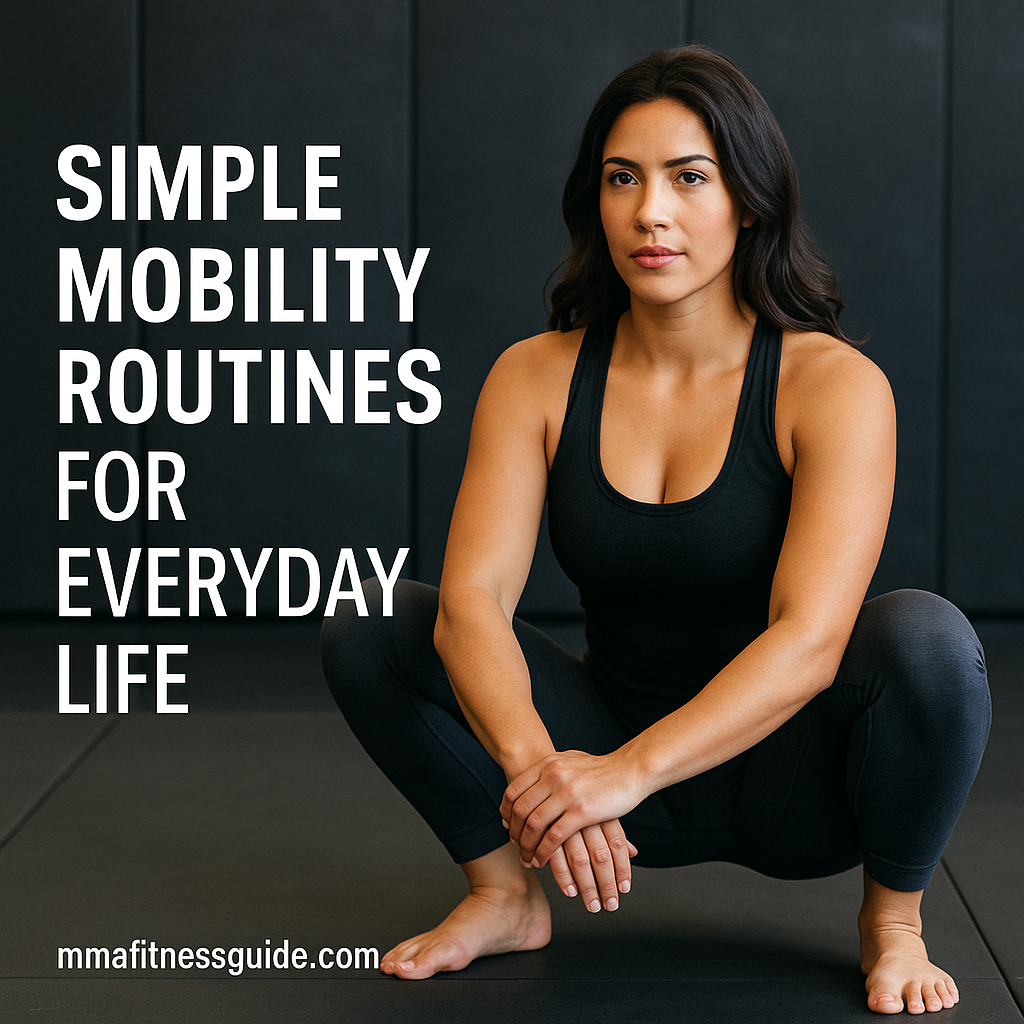
6. Deep Squat Hold — 1 minute
Sit into a deep squat with heels on the ground, chest tall.
If you can’t go all the way down, hold onto a wall.
Benefits:
- improves ankle mobility
- opens hips
- helps balance and lower-body strength
7. Hamstring Sweep — 1 minute
Step one foot forward, hinge down, and sweep your arms along the leg. Switch sides.
Benefits:
- lengthens hamstrings
- reduces lower-back tightness
- improves kicking range
8. Ankle Rocks — 1 minute
Place one foot forward and gently drive your knee over your toes. Switch feet.
Benefits:
- increases ankle mobility
- improves squat depth
- supports safe takedown entries
9. Wrist Circles + Wrist Stretch — 1 minute
Circle wrists, then gently pull fingers back and down.
Benefits:
- helpful for grapplers
- reduces wrist pain during training and computer work
10. Hip Flexor Stretch — 1–2 minutes
Take a low lunge position and gently push hips forward.
Benefits:
- reduces hip flexor tightness
- improves posture
- great for fighters who kick often
Optional Add-On: Evening Relaxation Routine (5 Minutes)
If you want extra recovery, add these before bed:
- Forward fold — 1 minute
- Child’s pose — 1 minute
- Pigeon pose or figure-four stretch — 2 minutes
- Deep belly breathing — 1 minute
This helps your body relax and improves sleep quality.
How Often Should You Do Mobility?
For everyday life:
5–10 minutes daily is ideal.
For fighters or active athletes:
10–15 minutes before or after training.
Consistency matters far more than intensity.
Signs Your Mobility Is Improving
You’ll know it’s working if you start to notice:
- reduced morning stiffness
- easier overhead movements
- deeper squats
- better posture
- easier breathing
- more fluid movement in training
Mobility improvements sneak up on you — slow but steady.
Common Mistakes to Avoid
❌ Moving too fast
Mobility should be controlled and smooth.
❌ Stretching through pain
Mild discomfort is okay — sharp pain is not.
❌ Only stretching one area
The whole body benefits when you focus on multiple joints.
❌ Doing mobility only when injured
Mobility is maintenance, not a quick fix.
Final Thoughts
Simple mobility routines can make every part of daily movement easier — from training to walking to sitting at work. You don’t need to be flexible or athletic to start. A few minutes of consistent movement each day keeps your joints healthy, your body loose, and your posture strong.
Move a little every day — your body will thank you.